


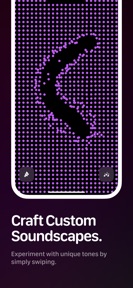


Zynth is a gesture-controlled synthesizer for iOS that maps touch and motion sensors to sound parameters for electronic music creation.
The App DNA
What makes this app unique?
The application serves users seeking an expressive, theremin-like interface that removes the cognitive friction of traditional keyboard-based synthesis.
For Musicians, sound designers, and visual artists looking for an expressive, gesture-controlled electronic instrument.
What does it look like?
Key features
Synthesizer parameters respond to device touch, tilt, and motion sensors.
Generates sine, square, triangle, and sawtooth waves for sound creation.
Includes echo, pitch, and modulation processing for sound shaping.
How much does it cost?
Zynth is distributed as a free tool with no observable monetization or in-app purchase gates.
Velocity
Dormant developmentShow more...
The app has not received a new build in 528 days, indicating a complete cessation of development activity. With only a single version released since inception, there is no evidence of ongoing maintenance or feature iteration. The project appears to be in a dormant state.
Who built it?
User Sentiment
What do users think recently?
How are ratings & reviews evolving?
Not enough recent reviews to extract reliable themes yet.
Read the full review analysisCompetition
Competitive landscape for Zynth: Interactive Synthesizer
How's the Music market?
Zynth occupies a niche within the Music category, focusing on expressive, touch-and-tilt synthesis rather than traditional sequencing or recording workflows. The lack of updates for over 500 days signals a maintenance-only posture that prevents it from competing with active, feature-rich synthesis tools.
Read the market outlookThe rivals identified
Unlock the deeper market read.
Access the full report for freeThe Analyst's Read
Key takeaways for Zynth: Interactive Synthesizer
Where is it heading?
The market for mobile synthesis is consolidating around tools that offer professional-grade export and MIDI integration. Zynth remains exposed because its feature set has not evolved to meet these expectations, which will likely lead to further user attrition as newer, more capable instruments arrive.
- The 17-month update gap indicates the application is in maintenance mode, which increases the risk of functional breakage during future OS updates.
- Lack of export or recording features prevents the application from integrating into professional workflows, limiting its long-term retention potential.
The SWOT
- Gesture-based sound control provides a unique, expressive interface for sound design.
- Zero-cost distribution lowers the barrier for entry for experimental musicians.
- Integration of MIDI output would enable Zynth to function as a controller for professional digital audio workstations.
- Implementation of a recording or export feature would allow users to capture and share their soundscapes.
Next best moves
Open-source the codebase because the current maintenance-mode status prevents feature growth → unlock community-led development.
The counter-intuitive read
The lack of updates is not a failure but a design choice…
Read the full takeSince the last report: The analysis has shifted from a general observation of dormancy to a specific critique of Zynth's functional gaps, identifying the lack of recording, export, and MIDI integration as the primary factors limiting its utility.
Bottom line
Zynth offers a distinct gesture-based synthesis experience, but the lack of updates since the initial launch limits its long-term viability. Transitioning to an open-source model would allow the community to maintain the codebase, unlocking the potential for Zynth to serve as a persistent experimental tool.
Unlock 2 critical frictions, 2 market threats and the analyst’s take.
Access the full report for freeFAQ
Is Zynth suitable for professional music production?
Does Zynth require a subscription or purchase?
Is Zynth still being updated?
Sources
Report last updated