


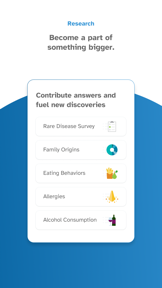
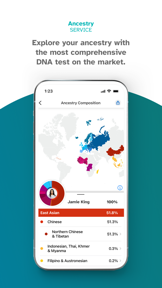


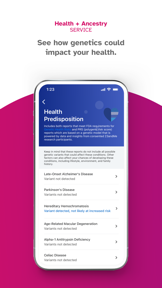


23andMe is a health and ancestry DNA testing app for adults, providing genetic insights and clinical-grade health reporting on iOS and Android.
The App DNA
What makes this app unique?
Users hire 23andMe to resolve questions about heritage and health risks, but the shift to subscription-gated features forces a trade-off between long-term data access and recurring costs.
For Adults interested in personal genetic discovery, ancestry mapping, and proactive health management.
What does it look like?
Key features
Genetic breakdown across 4,500+ regions
FDA-cleared genetic health risk and carrier status
Physician-initiated exome sequencing and blood testing
How much does it cost?
Tiered pricing anchors on entry-level kits with subscription revenue driven by ongoing health and clinical services.
Velocity
Active developmentUX improvementsnew contentShow more...
The app maintains an active development cadence, shipping approximately 0.6 releases per week across platforms. While iOS updates are consistently minor and focused on maintenance, the Android platform recently received a major feature update. The development trend is stable, with a clear distinction between platform-specific feature rollouts and general maintenance cycles. The publisher utilizes the Android changelog to communicate specific feature additions, while iOS notes remain opaque.
Who built it?
User Sentiment
What do users think recently?
Fresh user feedback skews mixed. Users appreciate detailed ancestry and health reports provide high value for personal discovery and familial connection, but report aggressive monetization and pay-to-view gating of previously free features frustrate long-term legacy users.
How are ratings & reviews evolving?
What users say, by theme
- Detailed ancestry and health reports provide high value for personal discovery and familial connection
- Aggressive monetization and pay-to-view gating of previously free features frustrate long-term legacy users
100 of 100 recent reviews analyzed · high confidence · Mixed overall
Read the full review analysisUnlock 1 user request, each backed by review evidence.
Access the full report for freeCompetition
Competitive landscape for 23andMe - DNA Testing
How's the Health & Fitness market?
23andMe maintains a high-rating baseline of 4.8 across 605,688 total reviews, anchoring its position as the primary health-focused DNA platform. The gap between its clinical-grade reporting and Ancestry's record-searching indicates a strategic divergence in user retention mechanics.
Read the market outlookThe rivals identified

By Ancestry.com
Dominates the genealogy-first DNA market with a massive user base and high-velocity feature updates.
- Integrates deep genealogical record-searching tools that extend far beyond simple genetic health reporting.
- Maintains a consistent release cadence of four major updates every six months to drive engagement.
- Leverages a massive historical database to provide context that pure health-focused apps cannot match.

Unlock the head-to-head verdict: where this rival wins, and where it loses.
Access the full report for freeThe Analyst's Read
Key takeaways for 23andMe - DNA Testing
Where is it heading?
The DNA testing market is consolidating around specialized health-tracking and deep genealogy records, leaving 23andMe in a high-stakes position between clinical utility and lifestyle discovery. The company must balance its research-driven revenue model with user privacy expectations to prevent further sentiment decline.
- Aggressive monetization of legacy features triggers user frustration, which compounds the churn risk among long-term legacy customers.
- Consistent addition of health-focused features like Biological Age biomarkers signals active investment in clinical-grade utility over maintenance mode.
The SWOT
- Research-driven data pipeline fuels scientific discovery
- Clinical-grade health reporting differentiates from genealogy-first rivals
- High-volume genetic database creates a barrier to entry
- Untapped B2B education partnerships
- Wearable integration for longitudinal health tracking
Next best moves
Audit authentication flows because login friction is a top-3 complaint → reduce churn among legacy users
+ 1 more prioritized moveThe counter-intuitive read
The shift toward subscription-gated health insights is not a failure of monetization…
Read the full takeFeature gaps
Deep genealogical record-searching (available in Ancestry but missing here)
Since the last report: The platform transitioned to an aggressive subscription-gated model for legacy features, triggering user complaints while simultaneously expanding clinical-grade health reporting.
Bottom line
23andMe leads in clinical-grade genetic insights, but aggressive paywalling of legacy features risks alienating the core user base, so the PM must prioritize authentication stability to protect long-term retention.
Unlock 3 critical frictions, 3 market threats, 1 more prioritized move and the analyst’s take.
Access the full report for freeReport last updated