







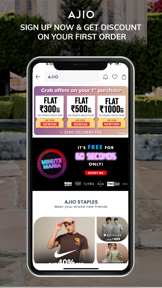


AJIO is a fashion and lifestyle retail app for iOS and Android, offering curated international brands and artisan-made ethnic products.
The App DNA
What makes this app unique?
Users open the app to discover on-trend apparel, but the current return-logistics friction displaces the trust required for repeat high-value purchases.
For Fashion-conscious consumers seeking a mix of international brands, contemporary trends, and artisanal ethnic wear.
What does it look like?
Key features
Exclusive distribution of global labels creates a unique inventory moat that drives high-value customer acquisition.
Artisan-made ethnic products differentiate the catalog from mass-market competitors, increasing brand loyalty.
Cross-selling electronics alongside fashion increases average order value (AOV) by capturing more wallet share.
How much does it cost?
The app operates as a direct-to-consumer retail channel for Reliance Retail, monetizing through product sales rather than subscription or ad-tier gates.
Velocity
Steady developmentUX improvementsperformancemonetizationShow more...
With 10 distinct versions released over the observed window, the app maintains a steady development cadence of approximately 0.38 releases per week. Development is focused on enhancing the shopping experience through features like UPI refund support, price drop alerts, and integration with Reliance Trends. While the most recent updates have shifted toward stability and performance improvements, the overall trend remains stable with consistent feature rollouts. The publisher provides clear, feature-rich release notes for major milestones while utilizing minor updates to address technical reliability.
Who built it?
Reliance Retail Private
7 apps tracked · Shopping
 Tira: Online Beauty Shopping
 Reliance Digital Shopping App
 Kelvinator-Connect to Comfort
 BPL - ConnectSmart
 Swadesh Online
 SHEIN India Fast Fashion
User Sentiment
What do users think recently?
Recent user voice shows a frustrated sentiment. Users appreciate wide variety of fashion clothing options at affordable price points attracts first-time shoppers to the platform and soft fabric quality and comfortable material choices keep customers satisfied with their apparel purchases, but report unresponsive customer support and automated ticket closures prevent resolution of refund and missing item disputes.
How are ratings & reviews evolving?
Weekly average review rating
What users say, by theme
- Wide variety of fashion clothing options at affordable price points attracts first-time shoppers to the platform
- Soft fabric quality and comfortable material choices keep customers satisfied with their apparel purchases
- Unresponsive customer support and automated ticket closures prevent resolution of refund and missing item disputes
120 of 9902 recent reviews analyzed · high confidence · Frustrated overall
Read the full review analysisUnlock 2 more frustration themes and 1 user request, each backed by review evidence.
Access the full report for freeCompetition
Competitive landscape for AJIO Online Shopping App
How's the Shopping market?
AJIO holds a #8 Free rank in the Indian Shopping category, but its high-friction return process creates a performance gap against competitors with more reliable logistics.
Read the market outlookThe rivals identified

By adidas
Both apps compete for fashion-conscious consumers in the Indian market, with AJIO providing a broad catalog of international brands and adidas capturing the same demographic through exclusive sportswear drops and loyalty-gated access.
- adiClub membership provides tangible value through points and exclusive access, whereas AJIO lacks a structured loyalty program.
- Fitness tracking integration allows adidas users to earn rewards while monitoring progress, a feature absent in AJIO.
- Exclusive product releases create a scarcity-driven retention loop that AJIO's broad catalog model does not replicate.
 ASOS - Discover Fashion OnlineContender
 Fashion Nova: Trendy ShoppingContender
 Zalando – Online fashionContender
 ABOUT YOU Online Fashion ShopContender
 MANGO - Online fashionContender
 CIDER - Clothing & FashionContender
 FARFETCH - Shop Luxury FashionContender
 Next: Shop Fashion & HomewareContender

Unlock the head-to-head verdict: where this rival wins, and where it loses.
Access the full report for freeThe Analyst's Read
Key takeaways for AJIO Online Shopping App
Where is it heading?
The Indian fashion retail market is consolidating around platforms that offer reliable post-purchase support, leaving AJIO exposed. Unless the team pivots from feature expansion to stabilizing the return infrastructure, the current sentiment trend will continue to erode the platform's acquisition funnel.
- Systemic failures in refund processing and return pickups erode user trust, which compounds the churn rate among first-time shoppers.
- The lack of payment flexibility (specifically cash-on-delivery) forces price-sensitive users toward competitors who offer lower-risk transaction models.
The SWOT
- Exclusive international brand partnerships create a defensible inventory moat.
- Indie collection differentiates the catalog from mass-market rivals.
- Implementing cash-on-delivery would mitigate prepaid-risk concerns for price-sensitive shoppers.
- Expanding the Indie collection could further capture the high-intent ethnic wear segment.
Next best moves
Audit refund logic because automated ticket closures are the #1 complaint theme → reduce refund-related churn.
+ 1 more prioritized moveThe counter-intuitive read
AJIO’s #8 category rank is a liability…
Read the full takeFeature gaps
365-day return policy (available in Quince but absent here) +1
Since the last report: Systemic post-purchase failures in refund and return logistics have become the dominant constraint on growth, forcing a strategic pivot toward payment flexibility and support-ticket auditing.
Bottom line
Stabilizing the return and refund infrastructure is the only way to protect the high-value customer base attracted by the international brand catalog. Without resolving these logistics failures, the app will continue to lose its most promising shoppers to competitors with more reliable post-purchase experiences.
Unlock 2 critical frictions, 2 market threats, 1 more prioritized move and the analyst’s take.
Access the full report for freeFAQ
Is AJIO suitable for buying international brands?
How does AJIO compare to Quince for fashion shopping?
Does AJIO offer cash on delivery?
What are some alternatives to AJIO for fashion?
Sources
- [1] Play Store listing, source
Report last updated