


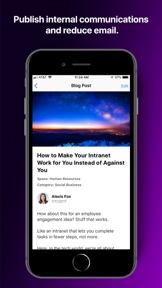
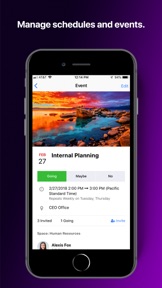


Axero is a mobile intranet application for enterprise document management and team communication on iOS and Android.
The App DNA
What makes this app unique?
Users hire Axero to maintain a centralized, secure connection to company documents and people while away from their primary workstation.
For HR, communications, and IT professionals at mid-to-large organizations.
What does it look like?
Key features
Build and deploy custom internal tools.
Ingest data from Box, Drive, and SharePoint.
Granular access control based on user persona.
How much does it cost?
B2B subscription model focused on enterprise sales, with pricing explicitly noted as negotiable and fair in customer testimonials.
Velocity
Maintenance developmentperformanceUX improvementsShow more...
The app currently ships at a maintenance cadence, with the most recent update occurring approximately one month prior to the current date. Development is focused on technical debt, specifically performance, stability, and bug fixes related to media and navigation. There is no evidence of new feature development or live operations in the observed data. The release pattern is stable but limited to maintenance-level updates.
Who built it?
User Sentiment
What do users think recently?
Fresh user feedback skews upset.
How are ratings & reviews evolving?
What users say, by theme
- Authentication failures prevent users from accessing their accounts within the mobile application environment
3 of 3 recent reviews analyzed · limited sample
Read the full review analysisUnlock 1 more frustration theme, each backed by review evidence.
Access the full report for freeCompetition
Competitive landscape for Axero
How's the Business market?
Axero maintains a niche position in the business intranet category, though its low review volume (3 reviews) suggests limited mobile-first adoption compared to broader productivity tools.
Read the market outlookThe rivals identified

By Vysor, Inc.
Vysor competes by offering deep device-level control and screen mirroring, which overlaps with Axero's goal of providing seamless, on-the-go access to digital workplace environments.
- Vysor provides low-latency hardware-level screen mirroring that Axero lacks for remote device management.
- Vysor offers a robust cross-platform desktop-to-mobile bridge that simplifies complex remote troubleshooting workflows.
- Vysor utilizes a freemium model with high-utility paid features that drive massive user adoption.


Unlock the head-to-head verdict: where this rival wins, and where it loses.
Access the full report for freeThe Analyst's Read
Key takeaways for Axero
Where is it heading?
The enterprise intranet market is consolidating around tools that offer seamless mobile-first access for frontline employees. Axero's current technical instability leaves it exposed to specialized competitors, so the PM must pivot from feature expansion to stability hygiene to prevent account attrition.
- Authentication failures in the latest release prevent account access, which directly erodes the daily active habit and increases churn risk.
The SWOT
- REST API integration functions as a central connectivity hub
- Role-based permission matrix supports enterprise-grade security compliance
- Education and frontline-worker partnerships as B2B distribution
- Native wearable integration for non-desk employees
Next best moves
Rebuild authentication flow because login failures are the top-reported blocker → increase daily active users
+ 1 more prioritized moveThe counter-intuitive read
The lack of mobile-first navigation is not just a UI flaw…
Read the full takeFeature gaps
Hardware-level screen mirroring (available in Vysor but missing here) +1
Since the last report: The competitive outlook has declined due to persistent authentication and navigation failures, with no new feature development to counter specialized market entrants.
Bottom line
Axero provides a secure, document-centric intranet for enterprise users, but the current mobile build's authentication and navigation flaws prevent it from serving as a reliable workplace companion, so the team must prioritize stability fixes over new feature development to retain existing enterprise accounts.
Unlock 3 critical frictions, 2 market threats, 1 more prioritized move and the analyst’s take.
Access the full report for freeFAQ
Is Axero suitable for frontline employees?
How does Axero compare to Vysor?
Does Axero have offline document access?
What is a mobile-first alternative for internal comms?
Sources
- [1] App Store, source
Report last updated