


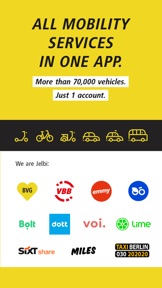
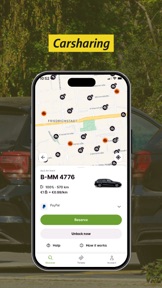


BVG Jelbi is a multi-modal mobility app for Berlin that integrates public transit, e-scooters, bikes, and car-sharing into a single booking interface.
The App DNA
What makes this app unique?
Users hire Jelbi to solve the 'last-mile' problem by connecting fixed-rail public transit with flexible micro-mobility, removing the need for multiple accounts.
For Berlin residents, commuters, and visitors requiring a single point of access for public transit and micro-mobility services.
What does it look like?
Key features
Aggregates real-time transit data for public transport, taxi, and sharing services into a single interface
Physical mobility hubs at transit nodes where users can rent, charge, or return shared vehicles
Digital subscription management for the national public transport ticket within the app
How much does it cost?
Monetization relies on a mix of transactional commissions from mobility partners and recurring subscription revenue from the Deutschlandticket.
Velocity
Maintenance developmentperformanceUX improvementsopaqueShow more...
The app has shipped only two minor updates in the last 8 days, with no evidence of new features or live operations. The release notes are generic and opaque, focusing exclusively on stability and technical improvements. Given the lack of feature-driven development or event-based content, the development momentum is classified as maintenance. The current cadence does not suggest active feature expansion.
Who built it?
Berliner Verkehrsbetriebe (BVG) - AöR
3 apps tracked · Travel
 BVG Fahrinfo: Routes & Tickets
 BVG Tickets: Train, Bus & Tram
User Sentiment
What do users think recently?
Fresh user feedback skews mixed. Users appreciate multimodal planning convenience, but report android app instability.
How are ratings & reviews evolving?
What users say, by theme
- Multimodal planning convenience
- Android app instability
Competition
Competitive landscape for BVG Jelbi: Mobility in Berlin
How's the Travel market?
Jelbi sits at #90 Free in the German Travel category, but the 1.4★ rating gap between Android and iOS platforms signals that technical instability is capping its growth potential.
Read the market outlookThe rivals identified

By Deutsche Bahn
As the primary national rail operator, DB Navigator competes directly for the daily commuter and long-distance traveler market in Berlin, serving as the default transit utility for millions.
- Offers nationwide rail coverage and long-distance booking, whereas Jelbi is strictly focused on Berlin-specific urban mobility.
- Features a massive user base with deep integration into national loyalty programs and the Deutschland-Ticket ecosystem.
- Provides advanced demand indicators and real-time capacity data that Jelbi currently lacks for regional rail lines.


Unlock the head-to-head verdict: where this rival wins, and where it loses.
Access the full report for freeThe Analyst's Read
Key takeaways for BVG Jelbi: Mobility in Berlin
Where is it heading?
Users report: The urban mobility market is consolidating around apps that offer both reliable transit data and physical infrastructure integration. Jelbi is currently exposed due to Android performance issues, but its physical station network provides a defensible position that will pay off if technical parity is achieved.
- Android rating instability (3.1★) creates a churn funnel toward DB Navigator, which offers more reliable long-distance scheduling.
- Expansion of physical Jelbi stations to 340+ locations provides a tangible utility that competitors lack, anchoring long-term user retention.
The SWOT
- 340+ physical Jelbi stations create a tangible infrastructure barrier to entry
- Single-registration model reduces friction for multi-modal transit users
- Expansion of Jelbi stations to underserved outer-city districts
- Integration of distance-based ticketing to simplify fare calculation
Next best moves
Rebuild Android booking flow because 3.1★ rating indicates critical technical debt → improve retention
+ 1 more prioritized moveThe counter-intuitive read
Jelbi's physical Jelbi stations are a stronger moat than its digital app features…
Read the full takeFeature gaps
Real-time capacity utilization data (available in DB Navigator) +1
Since the last report: The app faces increased competitive pressure from regional transit apps and a widening Android rating gap, signaling a decline in platform stability.
Bottom line
Jelbi holds a unique position through its physical mobility hubs, but the Android technical instability bleeds users to DB Navigator, so the PM must prioritize platform parity to defend the commuter base.
Unlock 2 critical frictions, 2 market threats, 1 more prioritized move and the analyst’s take.
Access the full report for freeReport last updated