



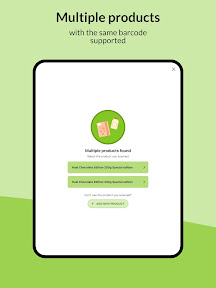
*This report is informational only and not medical advice.* Celery Free Scanner is a niche utility app designed for individuals with celery allergies to verify food safety via barcode scanning. It prioritizes low-friction access through a no-registration model and supports six languages, positioning it well for the European market. While it offers community-driven database updates, it faces competition from broader sensitivity trackers and established open-source platforms.
The App DNA
What makes this app unique?
For Individuals with celery allergies, their caregivers, or those on a medically restricted diet who need a quick, reliable way to verify food ingredients while shopping.
What does it look like?
Key features
Instant identification of food products via barcode to check for celery ingredients
Allows users to manually add missing product ingredients to help improve the database
Interface available in English, French, German, Italian, Portuguese, and Spanish
Full functionality available immediately without requiring user accounts
How much does it cost?
The app uses a low-friction, ad-supported model to maximize user acquisition, with a simple subscription path to remove ads for power users.
Velocity
Dormant developmentinternationalizationperformanceShow more...
The app has not received a major feature update since its initial release, with the most recent activity occurring in March 2025. Development appears to be in maintenance mode, as the only recorded updates consist of minor performance improvements and internationalization efforts. Given that more than 12 months have passed since the last update, the app is classified as a zombie project.
Who built it?
Food Barcode Scanner
8 apps tracked · Food & Drink
 Gluten Free Scanner
 Egg Free Scanner
 Sugar Free Scanner
 Soy Free Scanner
 Sesame Free Scanner
 Ginger Free Scanner
 Gluten Free Scanner
User Sentiment
What do users think recently?
How are ratings & reviews evolving?
Not enough recent reviews to extract reliable themes yet.
Read the full review analysisCompetition
Competitive landscape for Celery Free Scanner
How's the Food & Drink market?
The rivals identified

By Lluis Guiu
The most direct functional rival, mirroring this app's hyper-niche focus on a single dietary restriction with a utility-first interface.
- Niche-specific database optimization for Gluten vs this app's focus on Celery.
- Established community-verified product data spanning over a decade of operation.
- Simple, high-contrast UI designed for quick in-store scanning, similar to this app's core workflow.

Unlock the deeper market read.
Access the full report for freeThe Analyst's Read
Key takeaways for Celery Free Scanner
Where is it heading?
- v1.1.0 updates in March 2025 focused on performance, indicating active maintenance but no major feature expansion.
- Multi-language support across 6 languages suggests readiness for international scaling, particularly in the EU.
The SWOT
- No-registration required for immediate use
- Multi-language support (6 languages)
- Accessibility compliance for inclusive usability
- Community-driven data contribution model
- Integration with Open Food Facts to expand database instantly
- Expansion into a suite of single-allergen scanner apps
- Partnership with allergy advocacy groups for user acquisition
Next best moves
Integrate Open Food Facts API
+ 2 more prioritized movesFeature gaps
Multi-diet/allergen profile support (available in Food Intolerances and Spoonful) +3
Bottom line
Celery Free Scanner is a highly focused utility with excellent low-friction onboarding, but its hyper-niche scope is a strategic bottleneck. To survive against generalist giants like Yuka and authoritative peers like Spoonful, the PM must bridge the database gap via third-party integrations and establish medical credibility beyond simple community crowdsourcing.
Unlock 3 critical frictions, 3 market threats, 2 more prioritized moves and the analyst’s take.
Access the full report for freeReport last updated