




Collins Dictionary & Thesaurus is a comprehensive, offline-capable reference app for iOS that bundles unabridged dictionary and thesaurus data.
The App DNA
What makes this app unique?
Users hire this app for reliable, professional-grade linguistic data that functions without internet connectivity, avoiding the ad-supported friction of free alternatives.
For Students, language learners, and professionals requiring access to comprehensive, offline-capable dictionary and thesaurus data.
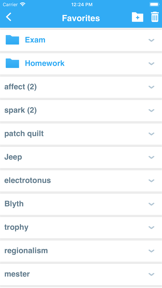
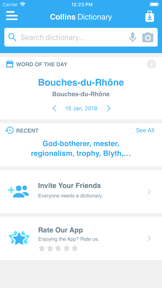
What does it look like?
Key features
Look up words in the camera viewfinder and display results in seconds
Displays word predictions as the user types
Finds dictionary entries via voice input for unknown spellings
How much does it cost?
Premium one-time purchase model at $39.99, positioning the app as a professional-grade reference tool.
Velocity
Dormant developmentShow more...
5 versions in history. Development pace: zombie.
Who built it?
MobiSystems
13+ apps tracked · Reference
 Quick Diagnosis & Treatment
 MobiOffice・Word Docs・Excel・PDF
 Webster’s College Dictionary
 MobiPDF・PDF Text Editor・Reader
 Collins Latin Dictionary
 Advanced Dictionary&Thesaurus
 MobiOffice - Sheets
 Collins World Dictionary
 MobiOffice - Docs
 Dorland’s Medical Dictionary
 Webster Roget's A-Z Thesaurus
 MobiScan: OCR Scanner・Scan PDF
User Sentiment
What do users think recently?
How are ratings & reviews evolving?
Not enough recent reviews to extract reliable themes yet.
Read the full review analysisCompetition
Competitive landscape for Collins Dictionary & Thesaurus
How's the Reference market?
The app maintains a 4.54 rating across 92 reviews, signaling a stable niche for professional users despite the lack of recent updates since 2018. Its paid-only model limits mass-market adoption compared to ad-supported competitors.
Read the market outlookThe rivals identified

By FB PUBLISHING LLC
Both apps target language learners and students with offline-first translation tools, but the rival captures the casual segment through a free, ad-supported model that directly competes with the Collins $39.99 entry barrier.
- Rival provides free access to 100,000 words, while Collins requires a $39.99 one-time purchase.
- Rival includes pronunciation support, a feature currently absent from the Collins feature set.
- Rival maintains a lightweight design for quick access, whereas Collins focuses on professional-grade, unabridged content.
 Advanced English Dictionary HDContender
 Collins Italian-EnglishContender
 Advanced Dictionary: LDOCE 6thContender
 Catalan-English DictionaryContender
 Czech/English DictionaryContender
 Afrikaans-English DictionaryContender
Unlock the head-to-head verdict: where this rival wins, and where it loses.
Access the full report for freeThe Analyst's Read
Key takeaways for Collins Dictionary & Thesaurus
Where is it heading?
The reference market is shifting toward interactive, AI-driven, and freemium models that prioritize daily engagement over static data. This app remains stable for its professional user base, but it must modernize its engagement loops to avoid long-term erosion by more dynamic competitors.
- The lack of feature updates since 2018 signals a maintenance-mode posture, which risks losing relevance to competitors with aggressive AI-driven release cycles.
- The $39.99 price point maintains a professional brand identity but limits the user base to academic power users, narrowing the potential growth ceiling.
The SWOT
- Unabridged content library functions as a professional-grade reference barrier
- Offline-first architecture reduces dependency on constant internet connectivity
- Education partnerships offer untapped B2B distribution channels
- Wearable integration would capture on-the-go professional queries
Next best moves
Pivot to a freemium model because the $39.99 barrier limits new-user acquisition → increase install velocity
+ 1 more prioritized moveThe counter-intuitive read
The app's lack of updates is not a…
Read the full takeFeature gaps
Daily word games and quizzes (available in Merriam-Webster) +2
Since the last report: The report transitioned from a high-level product description to a detailed competitive analysis, highlighting the app's static, premium-only model in an increasingly interactive and freemium-dominated market.
Bottom line
The app provides high-value, unabridged linguistic data, but its static, paid-only model is losing ground to interactive, freemium competitors, so the PM should pivot to a freemium model to capture casual users and drive daily engagement.
Unlock 2 critical frictions, 2 market threats, 1 more prioritized move and the analyst’s take.
Access the full report for freeReport last updated