


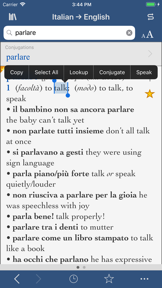
Collins Italian-English is a paid, offline-first reference dictionary and verb conjugator for Italian language learners on iOS.
The App DNA
What makes this app unique?
The app removes the need for cellular or Wi-Fi access during travel or study, providing a reliable, high-accuracy alternative to ad-supported, cloud-dependent dictionary tools.
For Language students and international travelers who require reliable, offline access to translation and conjugation tools.
What does it look like?
Key features
Full dictionary database and verb conjugator stored locally on the device.
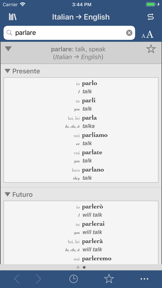
Complete conjugation tables for thousands of Italian and English verbs.
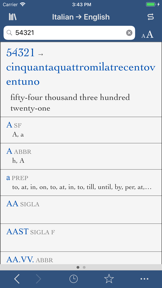
Converts numeric digits into written Italian or English text.
How much does it cost?
The $17.99 price point targets users who prioritize professional-grade data over ad-supported alternatives.
Velocity
Dormant developmentShow more...
5 versions in history. Development pace: zombie.
Who built it?
Ultralingua
13+ apps tracked · Reference
 Collins-Robert Concise
 Ultra Deutsch-Italienisch
 Ultralingua Spanish-German
 Ultralingua French-English
 Ultralingua francés-español
 Ultralingua Italian-Portuguese
 Ultralingua German-English
 Ultralingua italiano-inglés
 Ultralingua French
 Collins Subject Dictionaries
 Ultralingua Spanish-English
 Ultralingua
User Sentiment
What do users think recently?
Fresh user feedback skews excited. Users appreciate offline access to extensive language databases provides reliable utility for travelers and students.
How are ratings & reviews evolving?
What users say, by theme
- Offline access to extensive language databases provides reliable utility for travelers and students
- Interface design choices create friction during frequent search and navigation tasks
49 of 49 recent reviews analyzed · high confidence · Excited overall
Read the full review analysisUnlock 1 user request, each backed by review evidence.
Access the full report for freeCompetition
Competitive landscape for Collins Italian-English
How's the Reference market?
Collins Italian-English maintains a stable position in the Reference category with a 4.7-star rating across 396 total ratings. The $17.99 price point positions the app as a premium, utility-focused tool rather than a mass-market learning app.
Read the market outlookThe rivals identified

By Innnovative-Software
This app dominates the reference category through massive scale and high-utility features like OCR, directly competing for the same offline-first dictionary user base.
- Integrates OCR technology allowing users to translate text directly from physical documents or camera images
- Boasts a massive user base and review volume that creates a significant social proof barrier
- Provides integrated social sharing features that facilitate word-of-mouth growth and community-driven vocabulary expansion
 imiwa?Contender
 Advanced English Dictionary HDContender
 English Dictionary - LDOCE PROContender
 EijiroidContender
Unlock the head-to-head verdict: where this rival wins, and where it loses.
Access the full report for freeThe Analyst's Read
Key takeaways for Collins Italian-English
Where is it heading?
The language reference market is shifting toward interactive, AI-driven platforms that offer more than just static definitions. Collins Italian-English remains anchored in a static, offline-only model that, while accurate, is increasingly disconnected from the dynamic feedback loops users now expect.
- The 600-day update gap signals a maintenance-mode posture, which prevents the app from responding to the shift toward interactive AI-driven learning tools.
- User complaints regarding search interface friction indicate that the core utility is becoming harder to access, which compounds the risk of churn to modern rivals.
The SWOT
- HarperCollins lexicographical data provides superior accuracy for academic users
- Offline-first architecture removes connectivity dependency for travelers
- Implement trial-based monetization to lower entry barrier
- Add sentence analysis tools to compete with power-user rivals
Next best moves
Audit search interface and clear-button placement because user complaints flag navigation friction as a top frustration → reduce churn.
+ 1 more prioritized moveThe counter-intuitive read
The app's lack of updates is a feature, not a bug…
Read the full takeFeature gaps
OCR text translation (available in English Bangla Dictionary) +1
Since the last report: The outlook trend has declined from mixed to declining as the 600-day update gap persists, prompting a strategic pivot toward trial-based monetization and search interface improvements to address user churn.
Bottom line
Collins Italian-English relies on the authority of its HarperCollins data to justify a premium price, but the lack of feature iteration is eroding its competitive edge. Pivoting to a trial-based model would address the high entry barrier and unlock a larger user funnel.
Unlock 2 critical frictions, 2 market threats, 1 more prioritized move and the analyst’s take.
Access the full report for freeFAQ
Is Collins Italian-English worth the $17.99 price?
Does Collins Italian-English work without an internet connection?
How does this compare to free dictionary apps?
Are there any alternatives for language learning?
Sources
- [1] App Store listing, source
Report last updated