


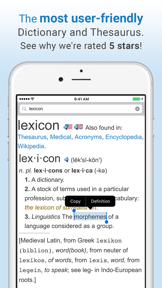

Dictionary. is a reference app for students and writers that aggregates definitions and synonyms from multiple publishers on iOS and Android.
The App DNA
What makes this app unique?
Users hire the app to consolidate diverse linguistic sources into a single search interface, reducing the time spent toggling between dictionaries.
For Students, language learners, and word enthusiasts requiring comprehensive, multi-source reference tools.
What does it look like?
Key features
Aggregates definitions and synonyms from multiple publishers including Webster's, Roget's, and American Heritage in a single search interface
Provides local storage of dictionary and thesaurus data for use without an active internet connection
Donates meals for hungry children based on user activity within the app
How much does it cost?
Freemium model relies on ad-supported free usage with a paid upgrade path for offline content expansion.
Velocity
Maintenance developmentperformanceopaqueShow more...
The app maintains a low-frequency release cadence, averaging approximately 0.06 releases per week over the analyzed period. Development is strictly limited to minor bug fixes and performance improvements, with no evidence of new features or live operations. The release history shows a decelerating trend, with significant gaps between updates. The publisher provides opaque release notes, indicating a focus on maintenance rather than active feature development.
Who built it?
Farlex
13+ apps tracked · Reference
 Dictionary and Thesaurus Pro
 Deutsch-Englisch Wörterbuch.
 Dictionnaire français-allemand
 Dictionnaire Français–Espagnol
 Deutsch-Spanisch Wörterbuch.
 Encyclopedia by Farlex
 WordHub
 Diccionario español.
 Spanish Dictionary & Thesaurus
 Book-Man
 Dicionário Português Inglês
 Deutsch–Französisch Wörterbuch
User Sentiment
What do users think recently?
Review voice lately leans upset. Users appreciate core dictionary utility provides reliable word definitions for students and writers, but report removal of previously purchased premium features forces users into ad-supported experiences.
How are ratings & reviews evolving?
What users say, by theme
- Core dictionary utility provides reliable word definitions for students and writers
- Removal of previously purchased premium features forces users into ad-supported experiences
100 of 102 recent reviews analyzed · high confidence · Upset overall
Read the full review analysisUnlock 1 user request, each backed by review evidence.
Access the full report for freeCompetition
Competitive landscape for Dictionary.
How's the Reference market?
Dictionary. maintains a massive scale with over 970,000 ratings on Android, yet the current monetization strategy creates a widening gap between legacy user expectations and the ad-heavy experience.
Read the market outlookThe rivals identified

By Xung Le
Both apps compete for language learners and reference users, with Dict Box capturing the offline-first, bilingual segment that Dictionary. currently struggles to serve due to ad-heavy monetization and offline access regressions.
- Dict Box includes a picture dictionary for visual learners, whereas Dictionary. relies on text-based definitions.
- Dict Box provides cross-device backup and sync, a feature absent in the current Dictionary. feature set.
- Dict Box includes a dedicated word reminder tool for vocabulary retention, which Dictionary. lacks.
 WordWeb DictionaryContender
 Word of the Day・VocabularyContender
 Dictionary Offline - Dict BoxContender
 Vocabulary Builder by MagooshContender
 Advanced Dictionary&ThesaurusContender
 English Dictionary *Contender
 Vocabulary Builder by LearningContender
 Dictionary - EnglishContender

Unlock the head-to-head verdict: where this rival wins, and where it loses.
Access the full report for freeThe Analyst's Read
Key takeaways for Dictionary.
Where is it heading?
The reference market is consolidating around high-velocity competitors that prioritize technical stability and user trust. Dictionary. is currently exposed because its monetization strategy directly conflicts with the core utility that users expect, so the app will continue to lose market share unless it restores purchase parity.
- Revocation of legacy premium status triggers high-churn sentiment, which erodes the brand authority built over the last decade.
- Technical regressions in offline dictionary access prevent use in low-connectivity environments, driving users toward more reliable competitors.
The SWOT
- Multi-source reference aggregation provides a single-stop utility for writers
- OS-level Share menu integration embeds the app into user workflows
- World Food Program partnership creates a unique altruistic engagement loop
- Monetize B2B partnerships using the existing 21-language library
- Expand into specialized academic or professional reference niches
Next best moves
Audit legacy purchase database because user sentiment is dominated by revocation complaints → restore trust and reduce churn.
+ 2 more prioritized movesThe counter-intuitive read
The app's massive install base is a liability, not an asset…
Read the full takeFeature gaps
Real-time contextual sentence examples (available in Reverso but absent here) +1
Since the last report: The app's competitive position has declined due to aggressive monetization tactics and the revocation of legacy user benefits, despite the addition of a new altruistic partnership.
Bottom line
Dictionary. holds its category lead through deep content aggregation but bleeds long-term users to ad-heavy monetization, so revenue growth hinges on restoring purchase parity to stop the churn.
Unlock 3 critical frictions, 3 market threats, 2 more prioritized moves and the analyst’s take.
Access the full report for freeReport last updated