


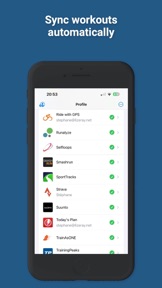


HealthFit is a medically-oriented fitness tracking app for Apple Watch users that provides advanced performance analytics and automated syncing to third-party platforms.
The App DNA
What makes this app unique?
Athletes use HealthFit to centralize disparate health data into a single, privacy-focused dashboard that avoids the recurring subscription costs of social-heavy fitness trackers.
For Athletes and fitness enthusiasts who use Apple Watch and require advanced performance analytics or automated syncing to third-party platforms.
What does it look like?
Key features
Background synchronization to 25+ platforms, reducing user friction for data portability.
Advanced metrics like critical power and mean maximal power charts for professional-grade insights.
Charts monitoring CTL, ALT, and TSB to track long-term training load.
How much does it cost?
The $6.99 one-time purchase model removes recurring subscription friction, positioning the app as a premium, ad-free tool for serious athletes.
Velocity
Active developmentUX improvementsperformanceShow more...
HealthFit maintains an active development pace, shipping 10 releases over the observed window with a cadence of approximately 0.77 releases per week. Development is consistently focused on enhancing data export flexibility, refining visualization tools like radar charts, and improving support for specific athletic activities. The release trend is stable, with the developer regularly alternating between feature-rich updates and stability-focused maintenance patches. The app continues to evolve its core functionality for power users who rely on detailed workout analytics.
Who built it?
User Sentiment
What do users think recently?
Recent user voice shows an excited sentiment. Users appreciate centralized data aggregation from multiple fitness platforms provides a comprehensive view of workout history and privacy-focused local data storage and lack of telemetry build trust with fitness enthusiasts, but report inaccurate ai-generated coaching summaries fail to account for high-intensity interval training dynamics.
How are ratings & reviews evolving?
What users say, by theme
- Centralized data aggregation from multiple fitness platforms provides a comprehensive view of workout history
- Privacy-focused local data storage and lack of telemetry build trust with fitness enthusiasts
- Responsive developer support and frequent feature updates maintain high user satisfaction over time
- Inaccurate AI-generated coaching summaries fail to account for high-intensity interval training dynamics
50 of 50 recent reviews analyzed · high confidence · Excited overall
Read the full review analysisUnlock 2 more frustration themes and 2 user requests, each backed by review evidence.
Access the full report for freeCompetition
Competitive landscape for HealthFit
How's the Health & Fitness market?
HealthFit holds a top-5 paid category rank in the US and Germany, demonstrating strong demand for specialized analytics. The app's ability to maintain these positions while avoiding subscription models signals high brand trust among power users.
Read the market outlookThe rivals identified

By Omron Healthcare Inc
OMRON connect competes for the same health-conscious user base by providing automated data logging for chronic health metrics, though it focuses on medical hardware integration rather than athletic performance.
- Hardware-linked data capture automates blood pressure and EKG logging directly from proprietary OMRON monitoring devices.
- Freemium pricing model allows users to access basic health tracking without an upfront purchase cost.
- Medication tracking features provide a dedicated log for chronic condition management alongside biometric health data.




Unlock the head-to-head verdict: where this rival wins, and where it loses.
Access the full report for freeThe Analyst's Read
Key takeaways for HealthFit
Where is it heading?
The market for specialized fitness analytics is consolidating, with users increasingly demanding both clinical accuracy and data portability. HealthFit is well-positioned to maintain its lead if it can resolve the accuracy issues in its AI-driven coaching features, which currently serve as a primary point of friction for its core athlete demographic.
- Active release cadence (roughly one update every two weeks) demonstrates a commitment to feature expansion rather than maintenance mode.
- User distrust regarding AI data handling, despite privacy claims, threatens the app's core brand identity as a local-only tool.
The SWOT
- One-time purchase model removes recurring subscription friction
- Local-only data storage builds trust with privacy-conscious athletes
- Automated background syncing to 25+ platforms reduces manual data entry
- Expand historical data interaction beyond one-year limit for long-term trend analysis
- Implement two-way historical data syncing to resolve platform inconsistencies
- Refine AI coaching logic to account for high-intensity interval training dynamics
Next best moves
Refine AI coaching logic for high-intensity interval training because users report miscategorization of HIIT sessions → improve training load accuracy
+ 1 more prioritized moveThe counter-intuitive read
The app's lack of a social graph is its primary retention mechanism…
Read the full takeFeature gaps
Two-way historical data synchronization (available in some fitness hubs but absent here) +1
Since the last report: Privacy-related sentiment regarding AI data handling has emerged as a primary threat, while the app has expanded its analytical capabilities to include long-term training load metrics.
Bottom line
HealthFit's privacy-first, one-time purchase model successfully captures the power-user segment that rejects social-heavy fitness subscriptions. Pivoting development resources toward refining AI coaching accuracy will address the primary churn risk and solidify the app's authority in clinical-grade fitness analytics.
Unlock 3 critical frictions, 3 market threats, 1 more prioritized move and the analyst’s take.
Access the full report for freeSources
- [1] App Store listing, source
Report last updated