

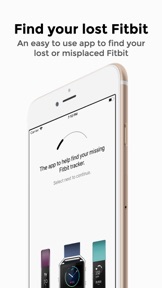


Finder for Fitbit is a utility app for iOS that locates misplaced Fitbit hardware using Bluetooth radio signal detection.
Product velocity
Dormant
Daily rank 🇺🇸
#96
Health & Fitness · paid
Sentiment
4.0
1k reviews
Nemesis

Wunderfind: Find Lost Device
The App DNA
What makes this app unique?
Users hire this app to recover lost wearable devices, serving an immediate, high-intent need that standard health-tracking apps do not address.
For Fitbit users who have misplaced their wearable device and require a signal-based recovery tool.
What does it look like?
Key features
Scans for specific Bluetooth radio signatures to locate hardware in proximity.
Provides visual indicators to guide users toward the general location of the detected device.
Supports a wide range of legacy and active Fitbit models.
How much does it cost?
Paid model at $3.99 per download targets users with an immediate, high-intent need to recover lost hardware.
Velocity
Dormant developmentperformanceplatform expansionShow more...
The app has been effectively abandoned, with no feature updates or meaningful development activity since the release in April 2026. Prior to this, the development history shows a significant gap between 2019 and 2026, indicating a lack of sustained investment. The latest release provided only generic performance improvements and platform compatibility updates. There is no evidence of active maintenance or live operations.
Who built it?
Deucks Pty
13+ apps tracked · Health & Fitness
 Halfy: Half-Price Groceries
 Halfy: Half Price Groceries
 Marco: Find Lost Bluetooth
 Bluetooth Finder
 Finder for Jawbone Lite - find your lost UP24, UP2, UP3 and UP4
 Finder for Xiaomi Lite - find your Mi devices
 Finder for Vívo Lite - find your Garmin tracker
 Finder for Misfit Lite - find your Shine and Flash device
 Health Sync for Fitbit Lite
 Spooki - Halloween Stickers
 Darts ScoreBoard
 Soothing Sounds Lite - Sleep better, stress less
User Sentiment
What do users think recently?
The recent review mood reads upset. Users appreciate core activity tracking features provide essential health data for daily fitness monitoring, but report post-update technical regressions cause widespread sync failures and missing health data visualizations.
How are ratings & reviews evolving?
What users say, by theme
- Core activity tracking features provide essential health data for daily fitness monitoring
- Post-update technical regressions cause widespread sync failures and missing health data visualizations
60 of 99 recent reviews analyzed · high confidence · Upset overall
Read the full review analysisUnlock 2 more frustration themes and 1 user request, each backed by review evidence.
Access the full report for freeCompetition
Competitive landscape for Finder for Fitbit
How's the Health & Fitness market?
Finder for Fitbit maintains a specialized position in the Health & Fitness category, currently ranking #67 Paid in the US. The reliance on a single-purpose utility model limits its reach compared to broader health-tracking apps that integrate device management.
Read the market outlookThe rivals identified
By Hendrik Folkerts
This app serves the exact same job-to-be-done as this app, focusing on locating Bluetooth devices with a significantly larger user base.
- Offers a broader device compatibility list including headphones and speakers beyond just fitness trackers
- Provides a visual distance indicator that helps users triangulate signal strength in real-time
Unlock the deeper market read.
Access the full report for freeThe Analyst's Read
Key takeaways for Finder for Fitbit
Where is it heading?
The utility market for Bluetooth finding is consolidating around free, multi-device tools that offer superior triangulation. Finder for Fitbit remains exposed by its paid-upfront model and narrow device focus, which will continue to compress install velocity as free alternatives improve their signal-processing accuracy.
- The lack of feature updates against free, multi-device competitors accelerates churn, as users migrate to tools that offer broader hardware support.
The SWOT
- Bluetooth radio signature detection functions as a focused utility moat for Fitbit hardware owners.
- Multi-model support for legacy Fitbit series captures users of discontinued hardware.
- Expansion into broader Bluetooth device tracking could neutralize the competitive advantage of specialized rivals.
Next best moves
Pivot to multi-device Bluetooth tracking because free rivals offer broader compatibility → increase addressable market.
The counter-intuitive read
The app's single-purpose nature is not a weakness…
Read the full takeFeature gaps
Real-time distance triangulation (available in Wunderfind but missing here) +1
Bottom line
Finder for Fitbit secures its niche through specialized Fitbit radio detection, but the lack of feature evolution against free, multi-device rivals threatens long-term viability, so the PM should prioritize a pivot toward multi-device support to defend the user funnel.
Unlock 2 critical frictions, 1 market threat and the analyst’s take.
Access the full report for freeSources
Report last updated