


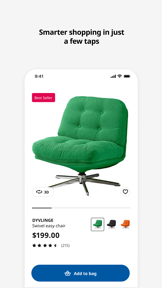


IKEA is a shopping and home design utility for homeowners and renters, providing AR visualization, in-store navigation, and order management on iOS and Android.
The App DNA
What makes this app unique?
Users hire the app to reduce the friction of physical furniture shopping and to validate design choices before purchase, serving as a bridge between inspiration and retail fulfillment.
For Homeowners and renters looking for furniture, home decor, and interior design inspiration.
What does it look like?
Key features
Provides pathfinding assistance within physical store layouts to locate products
Allows users to scan items while shopping in-store for faster checkout
Uses camera input to overlay virtual furniture products into the user's physical space
How much does it cost?
The app functions as a free utility to support physical retail operations and direct-to-consumer sales.
Velocity
Intense developmentShow more...
5 versions in history. Development pace: intense.
Who built it?
Inter IKEA Systems B.V.
13+ apps tracked · Shopping
 IKEA Greece
 IKEA Home smart 1
 IKEA – Home furnishings
 IKEA Qatar
 IKEA 宜家家居
 IKEA Shopping
 IKEA Home Services
 IKEA Türkiye
 IKEA Iceland
 IKEA Bahrain
 IKEA Indonesia
 IKEA Taiwan
User Sentiment
What do users think recently?
Fresh user feedback skews excited. Users appreciate in-store navigation utility, but report regional feature gaps.
How are ratings & reviews evolving?
Weekly average review rating
What users say, by theme
- In-store navigation utility
- Regional feature gaps
Unlock 1 user request, each backed by review evidence.
Access the full report for freeCompetition
Competitive landscape for IKEA
How's the Shopping market?
IKEA maintains a stable presence in the Shopping category, ranking #10 in Sweden and #12 in Norway. The high rating of 4.74 across 385,000+ reviews signals strong utility, though the lack of aggressive monetization suggests the app is a retention tool for physical retail.
Read the market outlookThe rivals identified

By Sam's Club
Sam's Club competes with IKEA by providing a Scan and Go feature that mirrors IKEA's Scan and Pay, targeting the same convenience-focused shopper who prioritizes skipping checkout lines.
- Sam's Club offers one-hour delivery options, while IKEA lacks direct-to-consumer delivery speed parity.
- Sam's Club provides real-time gas price tracking, a feature absent from the IKEA shopping experience.
- Sam's Club integrates Curbside Pickup, whereas IKEA focuses on in-store navigation and AR visualization.
 Matalan - Online ShoppingContender
 Kaufland - Shopping & OffersContender
 Next: Fashion & Clothing StoreContender
Unlock the head-to-head verdict: where this rival wins, and where it loses.
Access the full report for freeThe Analyst's Read
Key takeaways for IKEA
Where is it heading?
The home decor market is shifting toward integrated logistics, where speed of fulfillment is becoming the primary retention driver. IKEA's current posture is advantaged in physical retail but exposed in the digital-first segment, so the PM must prioritize logistics transparency to avoid losing share to generalist competitors.
- Consistent top-20 category rankings in European markets indicate the app remains a primary tool for IKEA shoppers.
- Regional feature gaps in the latest release drive user frustration, which risks eroding the current 4.7+ rating baseline.
The SWOT
- AR visualization reduces purchase hesitation [Conversion Metric]
- In-store navigation increases basket size [Retention Lever]
- B2B interior design partnerships [Market Segment]
- Wearable integration for shopping lists [Platform Gap]
Next best moves
Standardize feature parity across international markets because regional gaps drive negative sentiment → improve global rating baseline
+ 1 more prioritized moveThe counter-intuitive read
IKEA's reliance on physical store traffic is not a weakness, but a moat…
Read the full takeFeature gaps
Real-time aisle-and-bay inventory tracking (available in Lowe's but absent here) +1
Since the last report: The app has repositioned its core utility features as competitive differentiators while identifying new logistics-based threats and regional feature inconsistencies.
Bottom line
IKEA succeeds as a retail utility through strong in-store tools, but its lack of logistics-driven convenience leaves it exposed to Amazon, so the PM should prioritize delivery transparency to retain high-intent shoppers.
Unlock 2 critical frictions, 2 market threats, 1 more prioritized move and the analyst’s take.
Access the full report for freeFAQ
Is the IKEA app free to use?
How does IKEA compare to Amazon for home goods?
Can I use the IKEA app to check stock?
What is a good alternative for home design?
Report last updated