





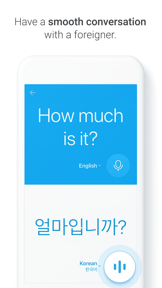


Naver Papago is an AI-powered translation app for travelers and language learners, available on iOS and Android.
The App DNA
What makes this app unique?
Users hire Papago for high-accuracy translation of East Asian languages, though the app's rigid language-pairing logic often forces users to switch to competitors for global tasks.
For International travelers, language learners, and business professionals requiring real-time translation across 14 supported languages.
What does it look like?
Key features
Automatic in-screen translation triggered when copying text in any third-party application
Simultaneous, split-screen voice translation for one-on-one dialogue
Captures passages via camera to create study notes for vocabulary review
How much does it cost?
The app operates as a free utility to support the broader Naver ecosystem, with no direct subscription or paid-tier gates.
Velocity
Active developmentShow more...
5 versions in history. Development pace: active.
Who built it?
NAVER
13+ apps tracked · Reference
 Papago Plus
 네이버 스마트스토어센터
 Whale - 네이버 웨일 브라우저
 네이버 시리즈온 - SERIES ON
 네이버 카페 – Naver Cafe
 PRISM: Live Streaming App
 클로바노트 - 음성 그 이상의 기록
 NAVER Dictionary
 NAVER Mail
 치지직
치지직 Naver SmartBoard - Keyboard
 네이버 스마트플레이스센터
User Sentiment
What do users think recently?
Fresh user feedback skews mixed. Users appreciate accurate translation performance for asian languages provides significant utility for daily communication needs.
How are ratings & reviews evolving?
Weekly average review rating
What users say, by theme
- Accurate translation performance for Asian languages provides significant utility for daily communication needs
- Forced language selection logic causes persistent errors when attempting to translate non-Korean language pairs
49 of 49 recent reviews analyzed · high confidence · Mixed overall
Read the full review analysisUnlock 1 user request, each backed by review evidence.
Access the full report for freeCompetition
Competitive landscape for Naver Papago - AI Translator
How's the Reference market?
Papago holds a dominant #1 position in the South Korean reference category, but its global footprint remains volatile with a #59 Free rank in the US. The gap between regional dominance and global performance signals a need for broader language support to compete with Google Translate.
Read the market outlookThe rivals identified

By Google
Both apps compete for the same international traveler and language learner audience, with Google Translate providing a 249-language library that directly challenges the 14-language limit of Naver Papago.
- Google Translate supports 249 languages, while Naver Papago is limited to 14 languages.
- Google Translate integrates into Android hardware triggers, whereas Naver Papago relies on its own Mini feature.
- Google Translate includes a Transcribe feature for real-time audio, which Naver Papago lacks.
 Microsoft TranslatorContender
 iTranslate TranslatorContender
 DeepL TranslateContender
 Translate Now - AI TranslatorContender
 Speak & Translate - TranslatorContender
 Voice Translator: AI TranslateContender
 Translate your Voice - Talk AIContender
 Translate AI - Live TranslatorContender

Unlock the head-to-head verdict: where this rival wins, and where it loses.
Access the full report for freeThe Analyst's Read
Key takeaways for Naver Papago - AI Translator
Where is it heading?
The translation market is consolidating around global-scale models that offer high accuracy across 100+ languages. Papago remains advantaged in East Asian linguistic nuances but faces churn pressure as non-Asian users encounter rigid language-pairing bugs, so the team must prioritize global language parity to avoid losing the international travel segment.
- Forced Korean-default logic in the latest version causes persistent translation errors, which drives users to switch to Google Translate.
- The addition of Pinyin support for Chinese demonstrates active feature investment, signaling the team is not in maintenance mode.
The SWOT
- Regional linguistic superiority in Korean/Japanese
- OS-level translation via Papago Mini
- Integrated study-note retention loops
- Expand offline language packs to include Spanish/French
- Improve image-overlay UI for better text readability
Next best moves
Audit language-pairing logic because users report forced defaults to Korean → reduce churn of non-Asian users
+ 1 more prioritized moveThe counter-intuitive read
The app's regional dominance is its primary risk…
Read the full takeFeature gaps
100+ language library (available in Google Translate but absent here) +1
Since the last report: The report reflects a shift toward identifying structural weaknesses in language-pairing logic and increased competitive pressure from global-scale translation models.
Bottom line
Papago holds its category lead through superior Asian-language accuracy but bleeds global users due to rigid language-pairing logic, so revenue growth hinges on fixing the Korean-default bug to retain international travelers.
Unlock 3 critical frictions, 3 market threats, 1 more prioritized move and the analyst’s take.
Access the full report for freeFAQ
Is Papago better than Google Translate?
Does Papago work offline?
Is Papago free to use?
Report last updated