


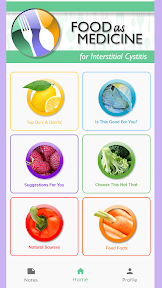


Interstitial Cystitis is a paid dietary and lifestyle guide for patients managing chronic bladder pain and related comorbidities on iOS and Android.
The App DNA
What makes this app unique?
Users hire this app to translate complex clinical nutrition data into actionable food choices, reducing the cognitive load of managing chronic pain flare-ups.
For Individuals diagnosed with Interstitial Cystitis or Painful Bladder Syndrome seeking evidence-based dietary and lifestyle management.
What does it look like?
Key features
Provides nutrition protocols for IC combined with secondary conditions like IBS, fibromyalgia, or celiac disease.
Visual graphic indicator showing if a specific food item is helpful or harmful based on the user's health profile.
Curated list of food items and recipes within food groups tailored to the user's specific health profile.
How much does it cost?
Paid model anchored at $3.99 per download, positioning the app as a specialized clinical tool rather than a subscription service.
Velocity
Steady developmentShow more...
Who built it?
Personal Remedies
13+ apps tracked · Medical
 High Cholesterol
 Gout +
 High Triglycerides
 Lupus +
 Food as Medicine
 Fatty Liver
 Low Histamine Diet +
 Kidney Stones - Oxalate
 Endometriosis Diet
 Rheumatoid Arthritis (RA)
 Breast Cancer
 Gallstones
User Sentiment
What do users think recently?
How are ratings & reviews evolving?
Not enough recent reviews to extract reliable themes yet.
Read the full review analysisCompetition
Competitive landscape for Interstitial Cystitis
How's the Medical market?
The app currently holds a #180 Grossing rank in the US Medical category. Its reliance on a one-time purchase model limits revenue velocity compared to subscription-based symptom trackers.
Read the market outlookThe rivals identified

By Food is Good, Inc.
High-velocity development and scanner-first UX directly compete with this app's dietary guidance model.
- Integrates barcode scanning technology to provide instant dietary compatibility feedback for grocery store shoppers.
- Maintains a massive, crowd-sourced database of food ingredients tailored to specific medical and dietary restrictions.
- High release cadence of 18 updates in six months signals a rapid, iterative product improvement cycle.

Unlock the deeper market read.
Access the full report for freeThe Analyst's Read
Key takeaways for Interstitial Cystitis
Where is it heading?
The medical dietary market is consolidating around high-utility, scanner-first tools that provide instant feedback. Without a shift toward automated tracking, this app will remain a static reference guide rather than a daily habit, limiting its growth to niche clinical referrals.
- The lack of barcode scanning creates a high-friction user experience, which forces shoppers to abandon the app for faster alternatives.
- The one-time purchase model provides low recurring revenue, which limits the budget available for rapid feature iteration against high-velocity rivals.
The SWOT
- Clinical credibility established by Harvard and Tufts-affiliated experts
- Comorbidity-specific dietary mapping replaces generic advice
- Integrate barcode scanning to match Fig's utility
- Add symptom-tracking logs to correlate food intake with pain flare-ups
Next best moves
Ship barcode scanning functionality because manual lookup is the top friction point for grocery shoppers → increase daily utility.
+ 1 more prioritized moveThe counter-intuitive read
The app's clinical authority is a liability if…
Read the full takeFeature gaps
Barcode scanning (available in Fig but absent here) +1
Since the last report: The app has refined its competitive positioning by elevating core features to differentiators and explicitly identifying critical feature gaps against market rivals.
Bottom line
The app provides high-quality clinical data but fails to solve the grocery-store friction point, so the PM must prioritize barcode scanning to prevent users from migrating to Fig.
Unlock 3 critical frictions, 2 market threats, 1 more prioritized move and the analyst’s take.
Access the full report for freeReport last updated