

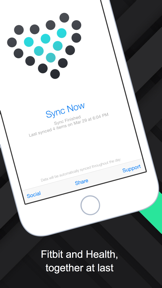
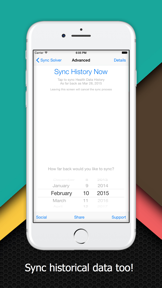
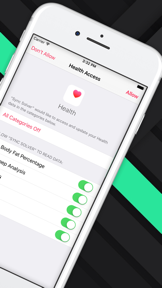
Sync Solver is a health-data bridge app that imports Apple Health metrics into the Fitbit platform for iOS and Android users.
The App DNA
What makes this app unique?
Users hire this app to consolidate fragmented health data into a single dashboard, serving the need for a unified view of fitness progress without manual entry.
For Health-conscious individuals using wearable devices to monitor fitness, sleep, and nutrition metrics.
What does it look like?
Key features
Imports data from Apple Health into the Fitbit environment
Monitors heart rate 24/7 and records zones during exercise via wearable integration
Calculates recovery status to recommend daily activity levels based on body metrics
How much does it cost?
Freemium model uses a content-gated subscription to monetize advanced health analytics and guided training.
Velocity
Dormant developmentperformanceopaqueShow more...
The development history shows a significant lack of activity, with the latest release occurring in April 2026 after a hiatus dating back to 2021. The cadence is effectively non-existent, as the release in 2026 appears to be a singular maintenance update rather than part of a recurring schedule. Given the multi-year gaps between updates, the app is classified as a zombie project with no evidence of ongoing feature development or live operations.
Who built it?
SCEP
13+ apps tracked · Health & Fitness
 Gravitarium
 Presets for Lightroom - Editor
 Free Car Racing Games
 Derby Quest: Horse Manager
 Screen Recorder Pro⋆
 Air File Share & Drop
 Sniper Assassin 3D Shooting
 Free Stickly Jump Game
 Free Chess Games
 Free Mahjong Games
 Free Solitaire Games
 Free Ping Pong Table Tennis
User Sentiment
What do users think recently?
The recent review mood reads upset. Users appreciate core activity tracking for steps and sleep remains a functional habit for long-term users, but report post-update technical regressions cause frequent app crashes and persistent blank screen errors during launch.
How are ratings & reviews evolving?
What users say, by theme
- Core activity tracking for steps and sleep remains a functional habit for long-term users
- Post-update technical regressions cause frequent app crashes and persistent blank screen errors during launch
99 of 99 recent reviews analyzed · high confidence · Upset overall
Read the full review analysisUnlock 1 more frustration theme and 1 user request, each backed by review evidence.
Access the full report for freeCompetition
Competitive landscape for Sync Solver - Health to Fitbit
How's the Health & Fitness market?
The app occupies a niche utility space for data bridging, but its #80 Paid rank in its category suggests limited reach compared to native ecosystem apps. The high volume of total ratings (1.26M+) reflects a legacy user base that is currently being eroded by technical instability.
Read the market outlookThe rivals identified

By Omron Healthcare Inc
OMRON connect competes for the same health-conscious audience by offering direct Apple Health integration and activity tracking, which overlaps with the core data-bridging utility of Sync Solver.
- OMRON connect integrates proprietary blood pressure and EKG hardware, while Sync Solver relies on third-party wearable data.
- OMRON connect includes built-in sharing tools for doctors and caregivers, a feature not present in Sync Solver.
 Fitbit to Apple Health SyncContender
 HealthFitContender
 Fitbit Sync to Apple HealthContender
 Power Sync: Fitness to HealthContender
 Pedometer++Contender
 Fitbit Sync to Health AppContender
 Fitbit to Apple Health Sync ·Contender
 Health Sync by appyhappsContender
Unlock the head-to-head verdict: where this rival wins, and where it loses.
Access the full report for freeThe Analyst's Read
Key takeaways for Sync Solver - Health to Fitbit
Where is it heading?
The health-tracking market is consolidating around platforms with deep social and behavioral features, leaving utility-only apps like this one increasingly vulnerable. The current technical instability accelerates this decline, and without a shift toward independent data handling, the app will likely lose its remaining user base to native ecosystem solutions.
- Technical regressions in the latest release (crashes, sync failures) drive immediate churn, which compounds the rating drag already visible on Android.
- Recent updates focus exclusively on stability and bug fixes, indicating the product is in maintenance mode rather than active growth.
The SWOT
- Apple Health sync provides a low-friction entry point for iPhone users
- Focused utility avoids the bloat of larger social health platforms
- Expansion into manual health logging to reduce dependency on wearable sync
- B2B partnerships with corporate wellness programs
Next best moves
Rebuild sync engine stability because sync failures are the top complaint → reduce churn
+ 1 more prioritized moveThe counter-intuitive read
The app's reliance on Fitbit is not a weakness but a necessary constraint…
Read the full takeFeature gaps
Photo-recognition meal logging (available in Lose It! but absent here) +1
Since the last report: The app has shifted from a free utility to a freemium model while suffering from severe technical regressions that have severely damaged user sentiment.
Bottom line
The app provides essential data-bridging utility, but the current technical instability is actively destroying the user base, so the PM must prioritize engine reliability over all new feature work to prevent total churn.
Unlock 3 critical frictions, 3 market threats, 1 more prioritized move and the analyst’s take.
Access the full report for freeReport last updated