


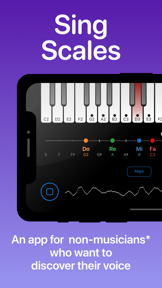


Sing Scales is a vocal training application designed to help users practice musical scales to improve vocal consistency and frequency control. It simplifies music theory by providing an interactive interface that allows users to begin singing immediately without prior musical knowledge.
Overview · Full Intel report in progress
The App DNA
What makes this app unique?
For Non-musicians and vocalists seeking a foundational tool for daily voice training.
What does it look like?
Key features
Provides access to over 100 common musical scales for vocal practice.
Allows users to adjust the speed of scale playback to match their training pace.
Enables customization of the scale progression to suit individual vocal needs.
Features a piano-based layout that enables users to start singing scales with a single tap.
How much does it cost?
Velocity
Steady developmentShow more...
4 versions in history. Development pace: steady.
Who built it?
SEQFX PTY
4 apps tracked · Music
 Time Nomad Astrology Charts
 3EM • Third Eye Meditation
 Planetos Nature Photography
User Sentiment
What do users think recently?
How are ratings & reviews evolving?
Not enough recent reviews to extract reliable themes yet.
Read the full review analysisCompetition
Competitive landscape for Sing Scales
How's the Music market?
The rivals identified

By Simply Ltd
Both applications target beginner vocalists seeking guided practice, but Simply Sing captures the market through real-time pitch-adaptive feedback while Sing Scales focuses on manual scale practice.
- Simply Sing provides real-time pitch-adaptive feedback during practice, whereas Sing Scales relies on static scale patterns.
- Simply Sing utilizes a subscription model with a free tier, while Sing Scales requires a one-time purchase.
- Simply Sing includes a vocal range assessment tool during setup, which Sing Scales lacks.
 Chet - Ear TrainingContender
 Vocalista: Learn to SingContender
 Vocalist: Learn to SingContender
 Learn to Sing - Perfect PitchContender
 Singing Lessons - Vocal CoachContender
 Tone - Learn Perfect Pitch!Contender
 Trill: Ear Training DailyContender
 Appcompanist: Vocal TrainingContender
Show 2 more


Unlock the head-to-head verdict: where this rival wins, and where it loses.
Access the full report for freeThe Analyst's Read
Key takeaways for Sing Scales
Where is it heading?
Bottom line
The app focuses on lowering the barrier to entry for vocal training by removing complex music theory requirements.
Report last updated