


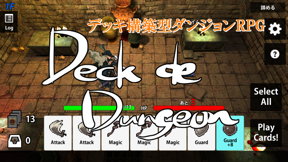
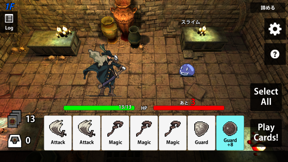
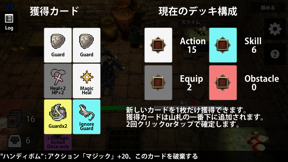
DeckDeDungeon is a roguelike deck-building RPG for single-player mobile users, featuring procedural dungeon crawling and hero-specific combat.
Product velocity
Dormant
Daily rank 🇺🇸
—
Games
Sentiment
3.8
1k reviews
Nemesis
Dungeon Tales : RPG Card Game
The App DNA
What makes this app unique?
Users hire this app for low-friction, rapid-fire roguelike sessions that avoid the complexity of modern meta-progression systems.
For Fans of roguelike dungeon crawlers and deck-building strategy games who prefer single-player experiences.
What does it look like?
Key features
Procedural dungeon generation with increasing difficulty levels
Collection and management of 239 unique cards to build hero decks
Choice of 12 distinct heroes with unique playstyles
Speed up gameplay by touching the screen or mouse-down
How much does it cost?
Ad-supported free model with no IAP, relying on high-frequency engagement to generate ad revenue.
Velocity
Dormant developmentShow more...
5 versions in history. Development pace: zombie.
Who built it?
yujiro komine
9 apps tracked · Games
 Buriedbornes 【ダンジョンRPG】
 Buriedbornes2
 B100X
B100X Ending Days
 DeckDeDungeon2 - Deck building RPG
 B10 Memories Never Last
 DeckDeFantasy
 Hollow INN
User Sentiment
What do users think recently?
Recent user voice shows a thrilled sentiment. Users appreciate minimalistic interface design allows players to focus on the core card combat mechanics and roguelike card combat loop provides high replayability for casual gaming sessions.
How are ratings & reviews evolving?
What users say, by theme
- Minimalistic interface design allows players to focus on the core card combat mechanics
- Roguelike card combat loop provides high replayability for casual gaming sessions
- Startup crashes on older hardware platforms disrupt the core gameplay experience
7 of 7 recent reviews analyzed · limited sample · Thrilled overall
Read the full review analysisUnlock 1 more frustration theme and 1 user request, each backed by review evidence.
Access the full report for freeCompetition
Competitive landscape for DeckDeDungeon
How's the Games market?
DeckDeDungeon maintains a niche presence in the roguelike category with a 3.89 average rating across 1,282 total platform ratings. The lack of IAP monetization relative to competitors like Dungeon Tales limits its grossing potential.
Read the market outlookThe rivals identified
By Oguz Tecimer
Dominates the deck-building roguelike niche with over 34,000 reviews, serving as the primary benchmark for user expectations in this category.
- Features a robust branching path system that forces strategic decision-making beyond simple card combat.
- Implements a persistent meta-progression system that rewards repeated runs with permanent deck upgrades.
- Offers a polished, high-fidelity UI that sets the visual standard for mobile deck-builders.


Unlock the head-to-head verdict: where this rival wins, and where it loses.
Access the full report for freeThe Analyst's Read
Key takeaways for DeckDeDungeon
Where is it heading?
The roguelike market is consolidating around titles with deep meta-progression and high update velocity, leaving DeckDeDungeon exposed. Without a shift toward permanent progression, the app will continue to lose long-term players to competitors that offer more substantial rewards for time invested.
- Startup crashes on older hardware platforms erode the daily active habit, which compounds the rating drag already visible on Android.
- Recent updates focused on stability and minor configuration displays, indicating the app is in maintenance mode rather than active feature expansion.
The SWOT
- Minimalist interface design reduces cognitive load during combat
- Accelerator function respects user time during repetitive grinding
- Procedural dungeon generation drives high session frequency
- Implement permanent card ownership to increase perceived value
- Add meta-progression systems to compete with genre leaders
- Optimize startup sequence for lower-end hardware configurations
Next best moves
Audit startup sequence because startup crashes are the top complaint → reduce churn
+ 1 more prioritized moveThe counter-intuitive read
The app's minimalistic, ad-light design is a liability, not a strength…
Read the full takeFeature gaps
Persistent meta-progression (available in Dungeon Tales but missing here) +2
Since the last report: The analysis shifted from a neutral feature overview to a critical assessment of the app's maintenance-mode status, highlighting hardware stability and lack of meta-progression as core retention risks.
Bottom line
DeckDeDungeon succeeds as a lightweight roguelike, but its lack of persistent progression and stability issues limit its ceiling, so the PM must prioritize stability and permanent card value to retain players against feature-rich competitors.
Unlock 3 critical frictions, 3 market threats, 1 more prioritized move and the analyst’s take.
Access the full report for freeReport last updated