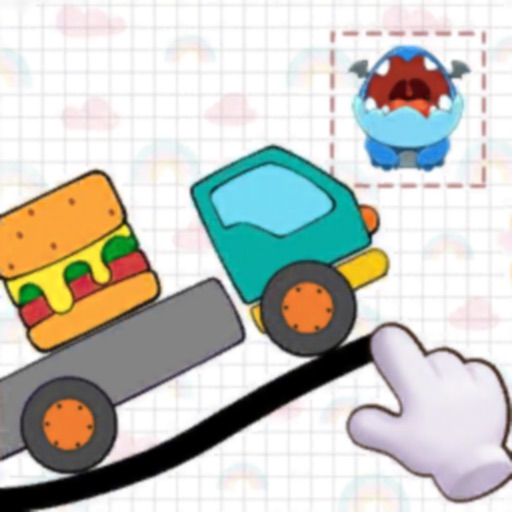






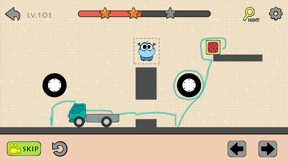

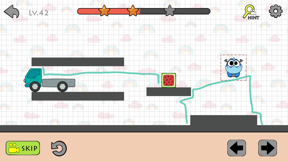

Dino Brain is a physics-based drawing puzzle game for mobile, where users solve spatial tasks to feed a virtual dinosaur.
The App DNA
What makes this app unique?
Users hire this game for low-stakes, tactile problem-solving that rewards creativity, serving the need for quick, satisfying brain-teaser sessions.
For Casual mobile gamers interested in physics-based puzzles and virtual pet progression.
What does it look like?
Key features
User-drawn lines function as physical objects to manipulate game items.
Visual modification of the in-game truck to match user style.
Virtual pet mechanics where dinosaurs grow over time.
How much does it cost?
Ad-supported model with in-app purchases for virtual goods and progression items.
Velocity
Active developmentShow more...
5 versions in history. Development pace: active.
Who built it?
ICEBEAR., JSC
13+ apps tracked · Games
 Merge Master: Dinosaurs Game
 Satisday ASMR: Cozygame
 Troll Thief Puzzle
 Satisoul: Perfectly Organize
 Merge Craft - Dinosaur Battle
 Delete Story - DOP Game
 Camo Hunt
 Merge Master: Idle Zombie War
 Liquid Sort Puzzle
 Tidy Home: Unpack and Decor
 Kitty Cat Escape
 Draw Love Story
User Sentiment
What do users think recently?
The recent review mood reads mixed.
How are ratings & reviews evolving?
Not enough recent reviews to extract reliable themes yet.
Read the full review analysisCompetition
Competitive landscape for Dino Brain - Draw Physics Line
How's the Games market?
The app maintains a niche physics-puzzle position on Android with a 2.6 rating across 1,580 reviews. The lack of recent major content updates relative to market leaders signals a decline in competitive relevance.
Read the market outlookThe rivals identified

By UNICO STUDIO
Dominates the brain-teaser puzzle category with massive scale and a consistent, high-frequency update cadence that keeps users engaged.
- Maintains a massive content library of thousands of levels that dwarfs smaller physics-based puzzle titles.
- Utilizes a highly polished, consistent art style that creates a recognizable brand identity across all levels.
- Aggressive cross-promotion network within the Unico Studio ecosystem drives consistent organic user acquisition at scale.



Unlock the head-to-head verdict: where this rival wins, and where it loses.
Access the full report for freeThe Analyst's Read
Key takeaways for Dino Brain - Draw Physics Line
Where is it heading?
The casual physics-puzzle market is consolidating around titles with high-frequency content updates and live-ops. Dino Brain remains exposed due to its static content model, so the PM must shift to a live-ops cadence to avoid further erosion of the user base.
- The 2.6★ Android rating indicates technical instability, which compounds the churn risk against high-velocity competitors.
- Static level design without seasonal events leads to user fatigue, accelerating the shift toward live-ops-heavy puzzle titles.
The SWOT
- Tactile physics-drawing mechanic sustains core engagement
- Virtual pet growth loop increases long-term retention
- Customizable vehicle assets drive personalization
- Implement seasonal events to drive recurring engagement
- Add social leaderboards to leverage the drawing mechanic
- Expand B2B partnerships for educational physics tools
Next best moves
Ship regular level-packs because the content library is the primary churn risk against Brain Test → increase DAU
+ 2 more prioritized movesThe counter-intuitive read
The app's low review count is a strategic advantage…
Read the full takeFeature gaps
Real-time competitive drawing (available in Draw it but absent here) +2
Since the last report: The report transitioned from a basic feature overview to a critical competitive assessment, highlighting technical instability and a lack of live-ops as primary churn risks.
Bottom line
Dino Brain holds its niche through tactile physics-drawing mechanics but bleeds users to content-heavy rivals, so the PM must prioritize a consistent level-release cadence to defend the casual-puzzle segment.
Unlock 3 critical frictions, 3 market threats, 2 more prioritized moves and the analyst’s take.
Access the full report for freeReport last updated