





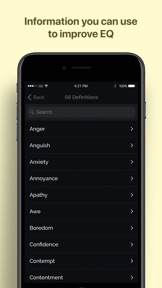
Emotions Dictionary is a reference app providing definitions and educational content on emotional intelligence for iOS users.
The App DNA
What makes this app unique?
Users hire this app for a low-friction, private way to identify and label emotional states without the overhead of data-heavy tracking or account registration.
For Individuals seeking to improve their emotional intelligence and self-regulation through basic educational reference material.
What does it look like?
Key features
Provides simple text-based definitions for various emotional states to assist with identification
Educational content explaining the mechanics and function of emotions to support self-management
How much does it cost?
The app operates as a free utility with no observable in-app purchases or subscription gates.
Velocity
Dormant developmentopaqueShow more...
The app has not received a single update in over four years, indicating a complete cessation of development. The last recorded release was a platform compatibility update for iOS 15. There is no evidence of active maintenance, feature development, or live operations. The project is classified as a zombie app due to the extreme duration of inactivity.
Who built it?
Quiet
13+ apps tracked · Reference
 Clean Manager: Storage Cleaner
 Bible daily verses & quotes
 Quran pro quotes & reminders
 Path - Help Me Decide
 Motivation for the new year
 Mentor AI - your daily guide
 WidgetPop
 Seed: Gamify No Nut Quit Porn
 WhatColors: AI Color Analysis
 Storage Cleaner: Cleanup Phone
 AppLock - Lock PIN Fingerprint
 QR Scan
User Sentiment
What do users think recently?
Fresh user feedback skews excited. Users appreciate privacy-focused design choices allow users to access emotional resources without intrusive data tracking or account registration and high-quality writing and visual design provide a professional resource for identifying and expressing complex human emotions.
How are ratings & reviews evolving?
What users say, by theme
- Privacy-focused design choices allow users to access emotional resources without intrusive data tracking or account registration
- High-quality writing and visual design provide a professional resource for identifying and expressing complex human emotions
- Limited emotional vocabulary depth fails to satisfy users looking for comprehensive academic or psychological reference lists
10 of 10 recent reviews analyzed · moderate confidence · Excited overall
Read the full review analysisUnlock 1 user request, each backed by review evidence.
Access the full report for freeCompetition
Competitive landscape for Emotions Dictionary
How's the Reference market?
The app maintains a 4.79-star rating across 171 reviews, serving as a niche reference utility in the Reference category.
Read the market outlookThe rivals identified

By The How We Feel Project, Inc.
This app is the direct functional evolution of an emotions dictionary, moving from static definitions to active emotional tracking and regulation.
- Integrates a visual mood-meter interface that maps emotions to physiological states for faster user identification.
- Provides evidence-based regulation strategies that move beyond simple definitions into actionable mental health exercises.
- Maintains a high-velocity release cadence with 8 updates in six months, signaling active product iteration.
 Daylio Journal - Mood TrackerContender
 Reflectly - Journal & AI DiaryContender
 stoic. journal & mental healthContender
Unlock the head-to-head verdict: where this rival wins, and where it loses.
Access the full report for freeThe Analyst's Read
Key takeaways for Emotions Dictionary
Where is it heading?
The mental health utility market is shifting toward active, data-driven regulation tools that provide immediate feedback. Emotions Dictionary remains stable but exposed, as its static reference model fails to compete with the high-engagement loops of modern rivals, so the team must pivot toward interactive features to avoid obsolescence.
- The privacy-first, ad-free model continues to drive positive sentiment, creating a loyal user base that rejects intrusive tracking.
- The lack of dynamic content updates forces users to seek more interactive alternatives, which accelerates churn toward high-velocity competitors.
The SWOT
- Privacy-first, ad-free model builds high user trust
- Professional writing quality provides a clean educational resource
- Expand database to include non-English emotional terms
- Implement home screen widgets to drive daily engagement
Next best moves
Ship home screen widgets because users request daily content access without opening the app → increase daily engagement
The counter-intuitive read
The app's lack of monetization is its primary competitive advantage…
Read the full takeFeature gaps
Mood-meter interface (available in How We Feel) +2
Since the last report: The app has entered a state of development dormancy, with its static reference model becoming increasingly obsolete against interactive, high-velocity mental health competitors.
Bottom line
The app succeeds as a privacy-focused reference tool, but its static nature limits long-term retention against interactive rivals, so the team must prioritize dynamic engagement features like widgets to remain relevant.
Unlock 2 critical frictions, 1 market threat and the analyst’s take.
Access the full report for freeReport last updated