


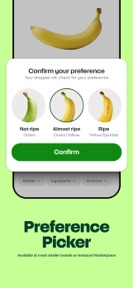


Instacart is a grocery and household item delivery marketplace that connects users to 40,000 retail locations across North America on iOS.
The App DNA
What makes this app unique?
It removes the time cost of in-store shopping for busy households by providing a single interface for diverse retail inventory.
For Time-constrained households and individuals seeking same-day grocery and household item delivery from local retailers.
What does it look like?
Key features
Direct communication channel with the assigned shopper to manage order changes or item substitutions.
Aggregated storefront access across 40,000 retail locations including Aldi, Costco, and Safeway.
Safety-focused fulfillment option allowing drop-off without direct interaction.
How much does it cost?
Transaction-based model where revenue is generated through service fees and retail partnerships rather than a flat subscription.
Velocity
Intense developmentperformanceopaqueShow more...
With 10 releases over the last 60 days, the app maintains an intense development velocity of approximately 1.16 releases per week. Despite this high frequency, the developer consistently utilizes opaque release notes that cite only general bug fixes and performance improvements, suggesting a reliance on server-side feature flags or A/B testing rather than traditional App Store feature deployments. The development trend remains stable and high-volume, prioritizing backend reliability and seamless user experience over visible feature updates. This pattern is characteristic of a mature platform that manages its feature set through continuous, non-versioned delivery.
Who built it?
Maplebear
8 apps tracked · Food & Drink
 Instacart Shopper: Earn money
 El Super
 Fiesta Mart
 Fairway Market Delivery
 Ridley's Family Markets
 Shop United
 Shop Cash Saver
User Sentiment
What do users think recently?
Review voice lately leans frustrated. Users appreciate convenient grocery delivery service provides a vital lifeline for busy parents and non-drivers and professional and kind shoppers often go above and beyond to ensure order accuracy, but report frequent delivery delays and missed time windows frustrate users who pay for priority service.
How are ratings & reviews evolving?
Weekly average review rating
What users say, by theme
- Convenient grocery delivery service provides a vital lifeline for busy parents and non-drivers
- Professional and kind shoppers often go above and beyond to ensure order accuracy
- Frequent delivery delays and missed time windows frustrate users who pay for priority service
120 of 4571 recent reviews analyzed · high confidence · Frustrated overall
Read the full review analysisUnlock 2 more frustration themes and 2 user requests, each backed by review evidence.
Access the full report for freeCompetition
Competitive landscape for Instacart: Groceries & Food
How's the Food & Drink market?
Instacart holds a #12 Free rank in the US Food & Drink category, maintaining a consistent presence despite intense competition. The reliance on transactional fees rather than a subscription model creates a retention gap compared to rivals like Uber Eats.
Read the market outlookThe rivals identified
By Bolt Technology
Bolt Food competes by offering integrated pickup options and real-time courier tracking, which directly addresses the fulfillment flexibility gaps currently present in the Instacart platform.
- Bolt Food provides integrated pickup options, a feature currently absent from the Instacart platform.
- Bolt Food offers real-time courier tracking, providing visibility that exceeds the current Instacart order status.
 DoorDash: Food, Grocery, MoreContender
 Uber Eats: Food & GroceriesContender
 talabat: Food, grocery & moreContender
 Just Eat - Food DeliveryContender
 Postmates - Food DeliveryContender
 Deliveroo: Food & ShoppingContender
 Shipt: Order Grocery DeliveryContender
 Gopuff - Grocery DeliveryContender

Unlock the head-to-head verdict: where this rival wins, and where it loses.
Access the full report for freeThe Analyst's Read
Key takeaways for Instacart: Groceries & Food
Where is it heading?
Casual grocery delivery is consolidating around subscription-based models that remove per-order friction, leaving Instacart's transactional structure exposed to high-frequency churn. Unless the platform introduces a recurring fee-waiver mechanism, it will continue to lose share of wallet to competitors that bundle grocery delivery into broader, high-retention memberships.
- Frequent delivery delays and missed time windows frustrate users who pay for priority service, signaling a breakdown in operational reliability.
- Subscription-based fee waivers from rivals incentivize high-frequency usage, directly draining Instacart's transaction-based funnel and accelerating churn pressure.
The SWOT
- 40,000-location retail network provides selection depth that restaurant-focused platforms cannot match
- Real-time shopper chat reduces order cancellation rates by enabling immediate resolution of out-of-stock items
- Localized pricing and inventory curation could capture niche demand in markets where generalist retailers have gaps
Next best moves
Launch a subscription-based fee-waiver tier because the current transactional model drives churn to subscription-based rivals → increase high-frequency retention
+ 1 more prioritized moveThe counter-intuitive read
Instacart's reliance on third-party retail inventory is a strength, not a weakness…
Read the full takeFeature gaps
Integrated pickup options (available in Bolt Food but absent here) +1
Since the last report: Instacart's competitive position has declined due to persistent operational failures and the lack of a subscription-based fee waiver, which leaves the platform vulnerable to churn against subscription-first rivals. The sentiment score dropped from 35 to 25 as users increasingly report deceptive billing and poor support responsiveness.
Bottom line
Instacart's retail network is a defensible asset, but the transactional fee model is a structural vulnerability in a subscription-first market. Transitioning to a recurring membership would unlock the high-frequency usage required to compete with DoorDash and Uber Eats.
Unlock 2 critical frictions, 1 market threat, 1 more prioritized move and the analyst’s take.
Access the full report for freeFAQ
Is Instacart worth paying for if I only order groceries occasionally?
How does Instacart compare to DoorDash for grocery delivery?
Does Instacart have a subscription option to avoid delivery fees?
What are the best alternatives to Instacart for grocery delivery?
Sources
Report last updated