

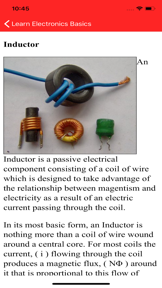
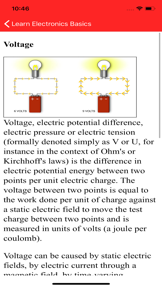

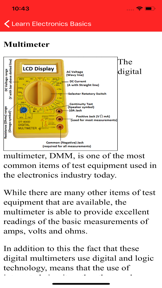

Learn Electronics Basics is a text-based reference app for electronics students and engineers on iOS.
The App DNA
What makes this app unique?
Users hire this app to quickly recall fundamental electrical concepts and hardware definitions, serving as a portable, offline-accessible technical dictionary.
For Students and electronics engineers seeking a reference guide for fundamental electrical concepts.
What does it look like?
Key features
Catalog of technical topics including Ohm's Law, diodes, transformers, and battery types.
Technical definitions for hardware tools and parts like multimeters, ammeters, and potentiometers.
Educational content covering solar systems, panel types, and energy conversion basics.
How much does it cost?
The app operates as a free educational resource with no visible monetization, subscription, or in-app purchase gates.
Velocity
Dormant developmentopaqueShow more...
The app has reached a zombie state, as there have been no updates or development activity for nearly six years. The last recorded release occurred in mid-2020, indicating a complete cessation of development momentum. There is no evidence of ongoing maintenance, feature updates, or live operations support.
Who built it?
ANIKET PATASKAR
10 apps tracked · Education
 English Stories - Offline
 Interview Questions & Answers.
 English Conversation.
 English Letter Writing Guide
 Story Book - Unique Stories
 Law Of Attraction Guide.
 IELTS Essays Writing
 Best Inspirational Stories
 Learn Psychology Basics
User Sentiment
What do users think recently?
How are ratings & reviews evolving?
Not enough recent reviews to extract reliable themes yet.
Read the full review analysisCompetition
Competitive landscape for Learn Electronics Basics
How's the Education market?
The app occupies a niche reference utility space, but its lack of updates since 2020 and negligible review count indicate a stagnant position relative to active educational competitors.
Read the market outlookThe rivals identified

By StudySwitch, Inc.
This app dominates the educational space by providing a structured, curriculum-aligned learning environment that directly competes for the same student demographic seeking foundational science knowledge.
- Offers a massive, validated question bank that provides significantly more practice depth than our current offering.
- Features a sophisticated subscription model that removes ads, creating a premium, distraction-free learning experience for students.
- Maintains high user trust through strict curriculum alignment, ensuring content remains relevant to formal academic standards.
 Sketchy LearningContender
 Tako Octo's Deep Sea AdventureContender
 DOPAContender
 Grade 11 Physical ScienceContender
Unlock the head-to-head verdict: where this rival wins, and where it loses.
Access the full report for freeThe Analyst's Read
Key takeaways for Learn Electronics Basics
Where is it heading?
The educational app market is consolidating around interactive, gamified platforms that offer assessment and mentorship. This app's static, text-heavy approach is increasingly misaligned with user expectations, so it faces a high risk of obsolescence unless it pivots to an active learning model.
- The lack of updates since 2020 signals a maintenance-mode posture, which will likely lead to further erosion of relevance against active competitors.
- Competitors are increasingly integrating gamified assessment tools, which creates a feature gap that makes this static reference app less attractive to students.
The SWOT
- Niche focus on professional-leaning electronics hardware basics provides a clear, non-generalized entry point for engineering students.
- Integration of a practice question bank could bridge the gap between static reference and active learning.
- Implementation of offline-first functionality would improve accessibility for students in low-connectivity environments.
Next best moves
Audit content for technical accuracy because the app has not been updated since 2020 → maintain user trust.
+ 1 more prioritized moveThe counter-intuitive read
The app's lack of monetization is not a strength but a terminal weakness…
Read the full takeFeature gaps
Interactive practice question bank (available in 中学理科 but absent here) +2
Since the last report: The intelligence report updated the competitive landscape to prioritize curriculum-aligned rivals and identified specific feature gaps in assessment and monetization.
Bottom line
The app provides a useful static reference for electronics basics, but its total lack of updates since 2020 leaves it vulnerable to gamified competitors, so the PM should prioritize adding interactive assessment tools to drive retention.
Unlock 2 critical frictions, 2 market threats, 1 more prioritized move and the analyst’s take.
Access the full report for freeReport last updated