



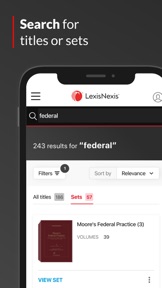




LexisNexis Digital Library is a reference app for legal professionals to access institutional eBook collections on mobile devices.
The App DNA
What makes this app unique?
The app removes the friction of carrying physical law volumes into courtrooms by providing a portable, offline-capable digital repository.
For Legal professionals and researchers who require mobile access to their organization's subscribed LexisNexis digital library.
What does it look like?
Key features
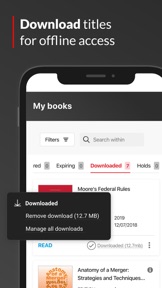
Download legal resources for use without internet connectivity in courtrooms or during travel.
Deep links from within eBooks to the Lexis Advance online service for expanded research.
Centralized hub for accessing recently read titles, highlights, and annotations.
How much does it cost?
The app functions as a free distribution channel for B2B institutional content, requiring a library-provided code for access.
Velocity
Maintenance developmentperformanceUX improvementsplatform expansionShow more...
LexisNexis® Digital Library currently follows a maintenance-level release cadence, averaging approximately one update every 3 to 4 months. Development is characterized by infrequent, minor stability patches rather than regular feature expansion. The last notable feature addition occurred in late 2024 with the introduction of CarPlay support, and the app has remained in a cycle of generic bug fixes since. With the latest release occurring 110 days ago, the development momentum remains focused strictly on technical upkeep.
Who built it?
OverDrive
5 apps tracked · Reference
 Libby, the library app
 Sora, by OverDrive Education
 OverDrive’s Digipalooza
 Libby: Read Library Books
User Sentiment
What do users think recently?
Fresh user feedback skews mixed. Users appreciate digital library access provides a convenient way to manage legal research and professional content and offline reading capabilities allow legal professionals to access critical research without a constant connection.
How are ratings & reviews evolving?
What users say, by theme
- Digital library access provides a convenient way to manage legal research and professional content
- Offline reading capabilities allow legal professionals to access critical research without a constant connection
- Technical instability and frequent crashes prevent users from accessing or reading their downloaded materials
24 of 24 recent reviews analyzed · moderate confidence · Mixed overall
Read the full review analysisUnlock 2 more frustration themes and 2 user requests, each backed by review evidence.
Access the full report for freeCompetition
Competitive landscape for LexisNexis® Digital Library
How's the Reference market?
LexisNexis Digital Library maintains a specialized role in legal research, though its 3.5-star average rating across 95 total reviews suggests significant friction. The app's maintenance-mode update cadence leaves it vulnerable to higher-velocity competitors in the reference space.
The rivals identified

By Faithlife Corporation
High-velocity development and deep scholarly feature sets make this the primary benchmark for professional-grade digital library experiences.
- Integrates advanced linguistic analysis tools that allow users to perform deep-dive original language word studies.
- Maintains a massive, proprietary ecosystem of interconnected theological resources that creates high user switching costs.
- Ships frequent feature updates, including nine releases in the last six months, outpacing standard reference apps.

The Analyst's Read
Key takeaways for LexisNexis® Digital Library
Where is it heading?
The legal reference market is consolidating around tools that offer deeper research integration and higher stability. LexisNexis Digital Library remains exposed: without a shift from maintenance to active stability engineering, it will lose its position as the primary mobile research companion for its institutional base.
- The maintenance-mode update cadence prevents the app from matching the feature velocity of reference rivals, which risks long-term professional churn.
- Persistent technical instability in the latest version erodes trust, as users cannot rely on the app for critical courtroom research.
The SWOT
- Institutional subscription integration functions as a B2B distribution barrier
- Refining annotation export tools could increase professional workflow integration
Next best moves
Audit authentication flow because library code errors are a top-cited barrier to entry → reduce new-user churn
+ 1 more prioritized moveThe counter-intuitive read
The app's maintenance-mode status is a strategic choice…
Read the full takeFeature gaps
Linguistic analysis tools (available in Logos but absent here) +1
Since the last report: Technical instability and annotation performance issues have eroded user sentiment, while the development cadence has slowed to a maintenance-only cycle. The app's reliance on institutional B2B integration remains its primary defense against higher-velocity competitors.
Bottom line
The app's value rests on its institutional B2B integration, but persistent instability threatens its utility as a professional tool. Addressing the authentication and crash barriers is necessary to defend the current user base against higher-velocity reference app competitors.
Unlock 2 critical frictions, 1 market threat, 1 more prioritized move and the analyst’s take.
Access the full report for freeFAQ
Is LexisNexis Digital Library free to use?
How does this app compare to Logos?
Does the app work offline?
What are some alternatives for legal research?
Sources
Report last updated