


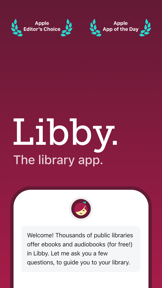




Libby is a digital library app for iOS and Android that enables users to borrow ebooks, audiobooks, and magazines using a local library card.
The App DNA
What makes this app unique?
Libby removes the financial barrier to reading by connecting users to existing public library digital collections, displacing the need for paid subscription services.
For Public library patrons seeking digital access to ebooks, audiobooks, and magazines.
What does it look like?
Key features
Direct authentication with local library systems via card number or phone number.
Direct delivery of borrowed ebooks to Kindle devices for U.S. library users.
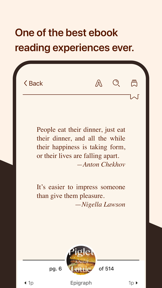
Download ebooks and audiobooks for offline reading or listening.
How much does it cost?
The app operates as a free utility funded by public library partnerships, with no subscription or in-app purchase model.
Velocity
Maintenance developmentperformanceShow more...
The app currently ships approximately 0.18 releases per week, placing it in the maintenance tier. Development is focused exclusively on minor bug fixes and stability improvements, with no evidence of new feature development or live operations. The release cadence has been stable but slow, with the latest release occurring over five weeks after the previous one. The publisher provides specific, albeit minor, technical context for each update rather than opaque notes.
Who built it?
OverDrive
5 apps tracked · Book
 Sora, by OverDrive Education
 LexisNexis® Digital Library
 OverDrive’s Digipalooza
 Libby: Read Library Books
User Sentiment
What do users think recently?
Review voice lately leans excited. Users appreciate free access to extensive digital library collections provides significant value for budget-conscious readers, but report audiobook playback issues including intermittent stops and volume inconsistencies disrupt the listening experience.
How are ratings & reviews evolving?
Weekly average review rating
What users say, by theme
- Free access to extensive digital library collections provides significant value for budget-conscious readers
- Audiobook playback issues including intermittent stops and volume inconsistencies disrupt the listening experience
120 of 1662 recent reviews analyzed · high confidence · Excited overall
Read the full review analysisUnlock 1 user request, each backed by review evidence.
Access the full report for freeCompetition
Competitive landscape for Libby, the library app
How's the Book market?
Libby maintains a top-tier presence in the Books & Reference category, holding the #2 Free slot in Australia and #4 in Canada. The consistent high-rank performance across international markets signals that the library-card-based value proposition remains a powerful driver of organic acquisition.
Read the market outlookThe rivals identified

By Audible, Inc.
Audible competes for the same audiobook listener base by offering professional narration and cross-platform synchronization, directly challenging the library-card-based model of Libby with a premium subscription service.
- WhisperSync enables progress tracking between text and audio, a feature missing from the Libby experience.
- Professional narration quality drives daily habit formation, whereas Libby relies on library-provided inventory availability.
- Subscription model provides instant access to titles, contrasting with the wait-list-dependent access in Libby.
 Goodreads: Book Tracker & MoreContender
 Hoopla: Your Library AnywhereContender
 Kobo Books & AudiobooksContender
 BookPlayerContender
 PocketBook reader - EPUB, PDFContender
 eBoox - fb2 ePub book readerContender
 CloudLibraryContender
 Apple BooksContender

Unlock the head-to-head verdict: where this rival wins, and where it loses.
Access the full report for freeThe Analyst's Read
Key takeaways for Libby, the library app
Where is it heading?
The digital library market is consolidating around institutional access, where Libby remains the dominant player. However, the lack of feature expansion in the latest release leaves the app exposed to competitors that prioritize social interaction and community-driven discovery, which will likely erode Libby's engagement metrics if left unaddressed.
- Persistent audio playback issues in the latest release erode user trust, which compounds the churn risk against more stable commercial audiobook alternatives.
- The maintenance-only update cadence suggests a focus on stability over growth, which risks losing share to rivals with faster feature-iteration cycles.
The SWOT
- Institutional library partnerships create a defensible barrier to entry for commercial ebook rivals
- Kindle integration provides a unique distribution advantage for U.S. library patrons
- Zero-cost access model sustains high organic install velocity across international markets
- Integrate social-reading features to increase engagement and compete with localized library platforms
- Expand digital copy inventory partnerships to reduce wait times for high-demand titles
Next best moves
Rebuild audio engine stability because intermittent playback stops are the top-cited technical complaint → improve long-term retention
+ 1 more prioritized moveThe counter-intuitive read
Libby’s maintenance-mode status is not a weakness but a strategic choice…
Read the full takeFeature gaps
Social-reading and book discussion features (available in iPusnas but missing here) +1
Since the last report: The competitive landscape analysis expanded to include social-reading rivals, signaling a shift in focus from internal technical debt to the threat of community-driven, government-backed platforms.
Bottom line
Libby’s institutional moat remains secure, but the lack of feature innovation leaves the platform vulnerable to socially-integrated rivals. Addressing the technical debt in the audio engine is the necessary move to defend the user base against more modern, responsive competitors.
Unlock 3 critical frictions, 2 market threats, 1 more prioritized move and the analyst’s take.
Access the full report for freeFAQ
Is Libby free to use?
How does Libby compare to commercial audiobook apps?
Does Libby work with Kindle?
What are the alternatives to Libby?
Sources
Report last updated