


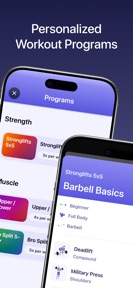


Liftr is a strength training and gym planning app for iOS and Android that provides manual workout logging and Apple ecosystem integration.
The App DNA
What makes this app unique?
Users hire Liftr to track lifting progress and sync health data with Apple Watch, avoiding the rigid, coach-led structures of competing fitness apps.
For Strength training enthusiasts who prioritize data-driven progress tracking and deep Apple ecosystem integration.
What does it look like?
Key features
AI-driven workout generation and personalized lifting analysis.
Deep sync with Health, Watch, and Shortcuts.
Detailed logging for sets, reps, and specialized training types.
How much does it cost?
The model gates analytical depth and hardware integration to drive subscription conversion among serious lifters.
Velocity
Steady developmentShow more...
Who built it?
User Sentiment
What do users think recently?
Review voice lately leans excited.
How are ratings & reviews evolving?
Not enough recent reviews to extract reliable themes yet.
Read the full review analysisCompetition
Competitive landscape for Liftr Workout & Gym Planner
How's the Health & Fitness market?
Liftr maintains a 4.49 rating on iOS across 136 reviews, positioning it as a specialized tool for power users rather than a mass-market fitness app. Its lack of chart-topping scale compared to rivals with 100,000+ ratings signals a niche footprint that relies on high-intent user acquisition.
Read the market outlookThe rivals identified

By Strava, Inc.
Both apps compete for the same health-conscious user base by providing fitness tracking, though they diverge on indoor strength training versus outdoor endurance activities.
- Strava uses social network effects to drive daily habit formation, while Liftr relies on manual entry.
- Strava gates performance metrics behind a subscription, whereas Liftr offers a freemium model without restrictive paywalls.
- Strava provides GPS-based route recommendations, while Liftr focuses on granular strength training data tracking.
 LADDER Strength Training PlansContender
 Hevy - Workout Tracker Gym LogContender
 Muscle Booster Workout TrackerContender
 Lyfta: Gym Workout Tracker LogContender
 Home Workout - No EquipmentsContender
 Strong Workout Tracker Gym LogContender
 Fitlist Workout Log & PlannerContender
 Gymverse: AI Gym Workout PlansContender

Unlock the head-to-head verdict: where this rival wins, and where it loses.
Access the full report for freeThe Analyst's Read
Key takeaways for Liftr Workout & Gym Planner
Where is it heading?
The strength-training market is consolidating around AI-driven automation, which threatens to render manual-entry journals obsolete for the average gym-goer. Liftr must transition from a passive logging tool to an active coaching engine to avoid being relegated to a niche utility.
- Automated routine engines in rival apps drain the casual-entry funnel, forcing Liftr to compete on feature parity rather than niche utility.
- Deep Apple Watch integration remains a high-retention anchor that prevents power-user churn to less hardware-integrated alternatives.
The SWOT
- Apple Watch integration creates hardware-level retention
- Freemium model avoids aggressive paywalls that drive churn
- Integrate social leaderboards to drive daily active usage
- Expand B2B partnerships with independent gyms for templates
Next best moves
Ship automated routine generation because manual entry is the top friction point → increase new-user retention
The counter-intuitive read
The reliance on manual logging is not a weakness but a moat…
Read the full takeFeature gaps
Automated routine generation (available in Fitbod but missing here) +1
Since the last report: The competitive outlook has shifted to mixed due to increased pressure from automated routine engines, prompting a clearer strategic focus on high-intent power users.
Bottom line
Liftr retains power users through deep Apple Watch integration, but its manual logging requirement limits mass-market appeal, so the team must prioritize AI-driven routine generation to compete with automated rivals.
Unlock 2 critical frictions, 2 market threats and the analyst’s take.
Access the full report for freeSources
- [1] App Store, source
Report last updated