


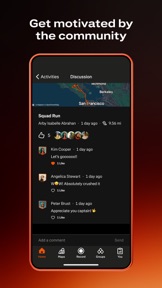


Strava is a social fitness tracking app for runners, cyclists, and outdoor athletes on iOS and Android.
The App DNA
What makes this app unique?
The platform removes the friction of manual activity logging by syncing with thousands of third-party devices, serving as a centralized training log.
For Active individuals ranging from casual walkers to competitive athletes who value community-driven fitness tracking and performance data.
What does it look like?
Key features
AI-driven analysis of workout metrics to provide personalized training insights. Revenue: Premium-tier gate.
Competitive ranking system for specific course segments where users race against community times. Revenue: Premium-tier gate.
Intelligent route recommendations based on aggregated, de-identified user activity data. Revenue: Premium-tier gate.
How much does it cost?
Subscription model gates advanced analytical and planning features, positioning the free tier as a social and tracking utility.
Velocity
Intense developmentUX improvementsperformancesocial featuresShow more...
With 10 releases over the last 60 days, the app maintains an intense development velocity of approximately 1.16 releases per week. The development team consistently balances performance-focused maintenance with functional feature updates, such as the recent addition of lock screen widgets and multi-select strength exercise tools. This stable, high-frequency release pattern indicates a mature, active product lifecycle focused on continuous UX refinement and platform-specific integration. The cadence remains steady and shows no signs of deceleration.
Who built it?
Strava
5 apps tracked · Health & Fitness
 Runna: Running Plans & Coach
 Recover Athletics
 Runna: Running Plans & Coach
 Strava: Run, Bike, Walk
User Sentiment
What do users think recently?
The recent review mood reads frustrated. Users appreciate community-driven activity tracking and social features keep users motivated to maintain their daily fitness streaks and comprehensive statistical breakdown of workout data provides valuable insights for athletes tracking long-term performance trends, but report aggressive subscription pop-ups and paywalling of basic features frustrate long-term users who feel the value proposition has declined.
How are ratings & reviews evolving?
Weekly average review rating
What users say, by theme
- Community-driven activity tracking and social features keep users motivated to maintain their daily fitness streaks
- Comprehensive statistical breakdown of workout data provides valuable insights for athletes tracking long-term performance trends
- Aggressive subscription pop-ups and paywalling of basic features frustrate long-term users who feel the value proposition has declined
120 of 5781 recent reviews analyzed · high confidence · Frustrated overall
Read the full review analysisUnlock 2 more frustration themes and 2 user requests, each backed by review evidence.
Access the full report for freeCompetition
Competitive landscape for Strava: Run, Bike, Walk
How's the Health & Fitness market?
Strava maintains a dominant category presence, ranking #1 Grossing in multiple international markets. The gap between its high chart rank and negative sentiment trend signals monetization friction that threatens long-term retention.
Read the market outlookThe rivals identified

By Hevy Studios S.L.
Both apps compete for the same active user base by using social network effects to drive retention, despite Strava focusing on outdoor GPS activities and Hevy on gym-based strength training.
- Hevy provides high-fidelity graph visualization for strength progression, while Strava relies on GPS-based segment leaderboards.
- Hevy offers native watchOS integration for gym sessions, while Strava focuses on outdoor activity recording.
 Nike Run Club: Running CoachContender
 Zwift: Indoor Cycling FitnessContender
 Google Health (Fitbit)Contender
 Sweatcoin Walking Step CounterContender
 Lyfta: Gym Workout Tracker LogContender
 komoot - hike, bike & runContender
 Relive: Hike & Ride MemoriesContender
 Garmin Connect™Contender

Unlock the head-to-head verdict: where this rival wins, and where it loses.
Access the full report for freeThe Analyst's Read
Key takeaways for Strava: Run, Bike, Walk
Where is it heading?
The outdoor fitness market is consolidating around hardware-integrated ecosystems that provide deep telemetry without subscription friction. Strava's current maintenance-mode stability issues leave it vulnerable to rivals like Garmin Connect, which offer superior performance-tracking utility.
- Persistent login and sync errors in the latest update compound the negative sentiment trend, driving users to explore alternatives.
- Aggressive subscription prompts during navigation frustrate the core user base, increasing churn risk among long-term athletes.
The SWOT
- Segment leaderboards drive daily engagement via community network effects
- Broad hardware integration reduces switching costs for multi-sport athletes
- Localized pricing could capture untapped ARPU in markets where rivals charge less
- Native sleep tracking integration would fill a key feature gap
Next best moves
Resolve login and sync failures because these technical regressions are the top churn driver → stabilize rating trajectory
+ 1 more prioritized moveThe counter-intuitive read
Strava's #1 grossing rank is a liability…
Read the full takeFeature gaps
Offline map caching (available in Komoot but missing here) +1
Since the last report: Technical instability and aggressive monetization are actively eroding user sentiment, with new complaints regarding map accuracy and navigation interruptions compounding existing sync failures.
Bottom line
Strava's social network effects remain a powerful retention anchor, but technical instability and aggressive paywalling are eroding the user base. Prioritizing core stability over new feature gating will protect the platform from hardware-integrated rivals like Garmin Connect.
Unlock 2 critical frictions, 2 market threats, 1 more prioritized move and the analyst’s take.
Access the full report for freeSources
Report last updated