


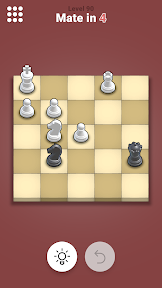


Pocket Chess is a board game app offering hundreds of tactical chess puzzles for beginners on iOS and Android.
Product velocity
Maintenance
Daily rank 🇺🇸
#173
Board · free
Sentiment
4.5
60k reviews
Nemesis

Chess Tactics Pro (Puzzles)
The App DNA
What makes this app unique?
The app removes the cognitive friction of full-board play, allowing users to practice pattern recognition during short periods of idle time.
For Casual chess players and beginners seeking to improve pattern recognition through bite-sized puzzle practice.
What does it look like?
Key features
Collection of hundreds of chess problems ranging from checkmate in two to checkmate in four moves.
Visual layout using smaller, focused boards to isolate key pieces and accelerate pattern recognition.
How much does it cost?
Ad-supported model with no identified premium subscription tier in store metadata.
Velocity
Maintenance developmentperformanceopaqueShow more...
Pocket Chess – Chess Puzzles is currently in a maintenance phase, having shipped no updates in the last 279 days. The development history shows a long-term trend of infrequent, minor technical updates rather than consistent feature expansion. The latest release provided only generic technical maintenance, and the lack of activity over the past nine months suggests a focus on stability rather than active growth.
Who built it?
Lessmore
7 apps tracked · Board
 Eatventure
 Arrows – Puzzle Escape
 We Are Warriors!
 Pocket Chess
 Arrows – Puzzle Escape
 Forge Master – Idle RPG
User Sentiment
What do users think recently?
Recent user voice shows a mixed sentiment. Users appreciate the core chess puzzle mechanic provides a satisfying and effective way for beginners to practice and simple and intuitive design makes the game accessible for quick sessions during short periods of boredom, but report aggressive ad frequency after every few moves disrupts the flow and discourages long-term engagement.
How are ratings & reviews evolving?
What users say, by theme
- The core chess puzzle mechanic provides a satisfying and effective way for beginners to practice
- Simple and intuitive design makes the game accessible for quick sessions during short periods of boredom
- Aggressive ad frequency after every few moves disrupts the flow and discourages long-term engagement
61 of 196 recent reviews analyzed · high confidence · Mixed overall
Read the full review analysisUnlock 1 more frustration theme and 1 user request, each backed by review evidence.
Access the full report for freeCompetition
Competitive landscape for Pocket Chess – Chess Puzzles
How's the Board market?
Pocket Chess maintains a 4.5-star rating across 60,327 total platform reviews, positioning it as a high-volume, casual alternative to professional training platforms. The lack of a premium subscription tier suggests a focus on ad-driven revenue over user-funded longevity.
Read the market outlookThe rivals identified
By Emmanuel Mathis
Both apps target chess players seeking puzzle-based practice. Chess Tactics Pro competes directly by offering an offline-first architecture and an Elo-based progression system that Pocket Chess lacks.
- Provides offline puzzle packs to allow users to train without an internet connection
- Includes an integrated analysis engine to help players understand tactical mistakes
- Features an adaptive Elo-based progress mode to drive daily session frequency
 Chess puzzles!Contender
 Checkmate puzzles - King HuntContender
 Chess Problems LiteContender
 Helpmate PuzzlesContender
 Checkmate - Chess PuzzlesContender
 Chess Puzzles · Sir BishopContender
 Daily Chess PuzzlesContender
 Chess Puzzles: Tactics TrainerContender

Unlock the head-to-head verdict: where this rival wins, and where it loses.
Access the full report for freeThe Analyst's Read
Key takeaways for Pocket Chess – Chess Puzzles
Where is it heading?
The casual chess puzzle market is consolidating around apps that offer tangible progression, such as ELO tracking or daily streaks. Pocket Chess remains exposed due to its lack of these retention loops and an ad strategy that prioritizes short-term inventory over long-term user habituation.
- Aggressive, unskippable ad frequency disrupts the core puzzle flow, which directly correlates with the high churn rate reported in recent reviews.
- The app remains in maintenance mode with no feature expansion, leaving it vulnerable to rivals with active live-ops and progression mechanics.
The SWOT
- Minimalist board design reduces cognitive load for beginners
- Introduce ELO-based streak tracking to increase retention
Next best moves
Pivot ad-delivery logic because ad frequency is the #1 complaint theme → increase session duration
+ 1 more prioritized moveThe counter-intuitive read
The minimalist board design is not just a…
Read the full takeFeature gaps
ELO-based rating system (available in Chess Tactics Pro but missing here) +1
Since the last report: Sentiment has shifted from positive to mixed as users report increasingly intrusive, unskippable ad experiences that disrupt the core puzzle loop. The app remains in a prolonged maintenance state, with no new feature releases recorded in the last nine months.
Bottom line
The current ad-heavy model creates a churn-prone experience that undermines the app's utility as a skill-builder. Pivoting to a more balanced ad-to-gameplay ratio would unlock higher session frequency and reduce the attrition currently driving users to ad-free rivals.
Unlock 2 critical frictions, 1 market threat, 1 more prioritized move and the analyst’s take.
Access the full report for freeFAQ
Is Pocket Chess suitable for beginners?
How does Pocket Chess compare to Lichess?
Does Pocket Chess have intrusive ads?
What is a free alternative to Pocket Chess?
Sources
Report last updated