


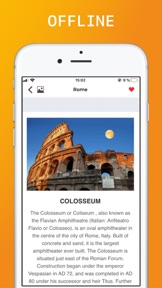
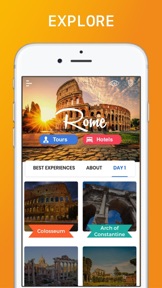

Rome Travel Guide Offline is a travel utility app providing regional maps and sightseeing itineraries for tourists on iOS.
The App DNA
What makes this app unique?
Users hire the app to eliminate roaming charges and navigation anxiety in Rome, relying on the offline-first contract to ensure utility without internet access.
For International travelers and tourists visiting Rome who require offline navigation and structured sightseeing itineraries.
What does it look like?
Key features
360-degree camera overlay identifying nearby points of interest and attractions
Downloadable regional maps and travel content requiring no internet connection
How much does it cost?
Freemium model utilizes a free entry-level guide to drive acquisition, with revenue generated through IAPs for expanded regional content.
Velocity
Maintenance developmentnew contentperformanceUX improvementsShow more...
The app has released only one update in the last five months, resulting in a cadence of approximately 0.05 releases per week. This frequency falls well below the threshold for active development, indicating a maintenance-focused lifecycle. The latest release focused on minor feature additions and performance improvements, but the lack of consistent updates suggests a lack of active development momentum.
Who built it?
Daniel Garcia
13+ apps tracked · Travel
 Dubai Travel Guide ..
 Vancouver Travel Guide
 Learn Flamenco Guitar
 Chicago Guía de Viaje
 Japan Travel Guide .
 Lake Garda Travel Guide
 Sydney Travel Guide .
 Sagrada Familia Visitor Guide
 Vatican Museums .
 Honolulu Travel Guide .
 American Museum of Nat History
 Singapore Travel Guide .
User Sentiment
What do users think recently?
How are ratings & reviews evolving?
Not enough recent reviews to extract reliable themes yet.
Read the full review analysisCompetition
Competitive landscape for Rome Travel Guide Offline
How's the Travel market?
The app maintains a 4.8-star rating across 444 reviews, signaling high satisfaction with its core offline utility. The lack of recent feature updates relative to the 2010 release date suggests a mature, maintenance-mode position in the travel category.
Read the market outlookThe rivals identified

By The National Trust
This app competes for the same travel-planning audience by offering offline-first utility and location-based discovery, directly challenging this app's value proposition as a primary travel companion.
- Massive user base and established brand authority provide a significant barrier to entry for niche guides.
- Integrated event discovery features keep users engaged long-term compared to this app's static city-guide model.
 Sedona GPS: Scenic Audio GuideContender
 Metropolitan Museum of Art NYCContender
 Vienna Travel Guide .Contender
 Miami Travel GuideContender
Unlock the head-to-head verdict: where this rival wins, and where it loses.
Access the full report for freeThe Analyst's Read
Key takeaways for Rome Travel Guide Offline
Where is it heading?
The travel utility market is consolidating around dynamic, event-aware platforms that offer more than static maps. Rome Travel Guide Offline remains advantaged for the specific offline-only segment, but the lack of active development leaves it exposed to churn as users seek more immersive, audio-guided experiences.
- The latest update focused on maintenance, signaling a stable but non-innovative posture that risks losing ground to dynamic competitors.
The SWOT
- Augmented reality tool provides immediate on-the-ground utility
- Offline functionality removes roaming-cost friction for international travelers
- Untapped B2B partnerships with local Rome hospitality providers
- Potential to expand into audio-guided walking tours
Next best moves
Refresh city content because current static data lacks modern POI relevance → increase repeat-user utility
The counter-intuitive read
The app's lack of updates is a feature, not a bug…
Read the full takeFeature gaps
Real-time event discovery (available in National Trust but absent here) +1
Since the last report: The app has transitioned into a maintenance-focused lifecycle, with competitive analysis now highlighting the risks of static content against dynamic, event-aware travel platforms.
Bottom line
Rome Travel Guide Offline maintains a stable niche through its offline-first utility, but the lack of content updates risks long-term churn as travelers migrate to dynamic, event-aware platforms, so the PM should prioritize a content-refresh cycle to defend against modern entrants.
Unlock 2 critical frictions, 2 market threats and the analyst’s take.
Access the full report for freeReport last updated