


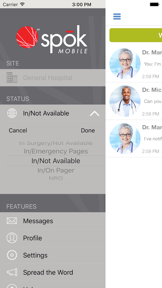
Spok Mobile is a clinical messaging and alerting application for healthcare and public safety professionals, requiring enterprise-level system connectivity.
Product velocity
Maintenance
Daily rank 🇺🇸
—
Business
Sentiment
1.7
474 reviews
Nemesis
Fragmented field
The App DNA
What makes this app unique?
Clinicians hire the app to receive time-sensitive patient alerts and manage on-call schedules, but the current reliability failure forces them to manually check for pages, which defeats the purpose of an automated alerting tool.
For Healthcare professionals, clinicians, and public safety personnel working within hospital or government systems.
What does it look like?
Key features
HIPAA- and HITECH-compliant encrypted messaging for healthcare teams
Automated delivery of patient alerts, code calls, and test results to mobile devices
Dynamic, enterprise-wide management of clinician schedules accessible from any device
How much does it cost?
Monetization is exclusively B2B, requiring an enterprise-level connection to the Spok platform rather than individual consumer payments.
Velocity
Maintenance developmentnew contentperformanceShow more...
The app exhibits a maintenance-level cadence, with only two releases identified over the last six months, averaging approximately 0.08 releases per week. Development is currently focused on minor stability and performance improvements rather than new feature delivery. The latest release introduced PDF attachments, but the overall release frequency indicates a low-intensity development cycle. There is no evidence of live-ops activity or frequent feature iteration.
Who built it?
User Sentiment
What do users think recently?
Review voice lately leans upset. Users report critical notification failures on android devices prevent users from receiving urgent medical pages reliably.
How are ratings & reviews evolving?
What users say, by theme
- Critical notification failures on Android devices prevent users from receiving urgent medical pages reliably
71 of 101 recent reviews analyzed · high confidence · Upset overall
Read the full review analysisUnlock 1 more frustration theme and 1 user request, each backed by review evidence.
Access the full report for freeCompetition
Competitive landscape for Spok Mobile
How's the Business market?
Spok Mobile maintains a niche B2B position in clinical alerting, anchored by a 1.78-star rating on Android and 1.63-star rating on iOS. The low ratings relative to its enterprise-critical function signal that current reliability issues are creating a significant gap between institutional contract value and end-user utility.
Read the market outlookThe rivals identified
Unlock the deeper market read.
Access the full report for freeThe Analyst's Read
Key takeaways for Spok Mobile
Where is it heading?
The clinical communication market is consolidating around reliable, EHR-integrated platforms, leaving Spok Mobile exposed due to its current technical instability. Unless the latest release cycle shifts from general bug fixes to a fundamental rebuild of the notification service, the platform will continue to lose the trust of clinicians, eventually inviting hospital systems to seek more stable alternatives.
- Persistent notification failures in the latest release erode user trust, which compounds the rating drag already visible on Android.
- The reliance on force-closing the app to manage alerts creates a crash-loop, which directly disrupts mission-critical clinical communication.
The SWOT
- EHR integration creates high switching costs for hospital systems
- On-call scheduling centralizes administrative workflows for clinical teams
- Wearable integration could solve the missed-notification complaint for clinicians
- Granular notification settings would reduce the need for force-closing
Next best moves
Rebuild Android background notification service because it is the #1 complaint theme → restore reliability
+ 1 more prioritized moveThe counter-intuitive read
The app's biggest risk is not a competitor feature set…
Read the full takeFeature gaps
Mass SMS/MMS campaign management (available in SimpleTexting) +1
Since the last report: The platform is facing a critical reliability crisis on Android, where notification failures and crash-loops are undermining its core value proposition as a clinical alerting tool.
Bottom line
Spok Mobile provides essential clinical workflow integration, but the core alerting function is failing due to Android notification instability, so the PM must prioritize background service reliability to prevent institutional churn.
Unlock 2 critical frictions, 2 market threats, 1 more prioritized move and the analyst’s take.
Access the full report for freeReport last updated