


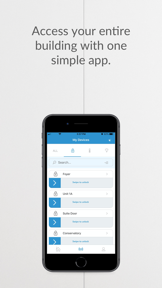


STRATIS 2.0 is a mobile IoT management app for residents of smart-enabled multifamily properties, available on iOS and Android.
The App DNA
What makes this app unique?
Residents hire STRATIS to manage building-level access and unit-level smart devices through a single interface, replacing physical keys and disparate manufacturer apps.
For Residents of multifamily properties and student housing equipped with STRATIS-compatible smart building infrastructure.
What does it look like?
Key features
Digital keys for unit locks, elevators, and common areas via mobile device
Remote control of thermostats, lighting, and water heaters through a unified dashboard
How much does it cost?
Monetization occurs at the B2B level through property management contracts and enterprise smart building suites.
Velocity
Maintenance developmentopaqueperformanceShow more...
The app ships approximately 1 release per week, but the release notes are consistently opaque, focusing solely on generic bug fixes and improvements. There is no evidence of new features, content, or live-ops events in the observed data. Development appears to be in a maintenance phase, prioritizing stability and minor patches over feature expansion. The cadence is stable but lacks substantive updates.
Who built it?
User Sentiment
What do users think recently?
How are ratings & reviews evolving?
Not enough recent reviews to extract reliable themes yet.
Read the full review analysisCompetition
Competitive landscape for STRATIS 2.0
How's the Lifestyle market?
STRATIS maintains a niche position in the Lifestyle category, anchored by its B2B2C model. The 0.9★ rating gap between iOS and Android indicates that the current Android build fails to meet the performance baseline set by the iOS version.
Read the market outlookThe rivals identified

By Google
Google Home competes directly for the central hub position in the smart home, vying for control over the same IoT devices and automation routines that STRATIS manages.
- Massive ecosystem compatibility allows users to integrate thousands of third-party devices beyond specialized property management hardware.
- Advanced AI-driven Gemini integration provides natural language automation that significantly outperforms standard rule-based smart home scheduling.
- Ubiquitous brand presence and deep OS-level integration create a frictionless onboarding experience for non-technical residential users.


Unlock the head-to-head verdict: where this rival wins, and where it loses.
Access the full report for freeThe Analyst's Read
Key takeaways for STRATIS 2.0
Where is it heading?
The smart apartment market is consolidating around platforms that offer both infrastructure control and AI-driven automation. STRATIS remains advantaged in the B2B space but exposed to consumer-first competitors, so the PM must bridge the Android performance gap to maintain resident retention.
- The 0.9★ rating gap on Android suggests technical regressions in the latest build, which increases churn risk for non-iOS residents.
- Recent updates focus on infrastructure stability rather than feature expansion, indicating a defensive posture against market-leading smart home hubs.
The SWOT
- Property-wide network connectivity ensures device reliability
- B2B2C distribution model secures captive resident user base
- SOC 2 Type 2 security certification builds institutional trust
- Expand service request marketplace to include third-party vendors
- Integrate wearable access triggers for common areas
Next best moves
Audit Android build stability because the 0.9★ rating gap vs iOS indicates platform-specific regression → recover Android user sentiment
The counter-intuitive read
The reliance on property management contracts is a moat, not a weakness…
Read the full takeFeature gaps
Universal third-party device compatibility (available in Google Home) +1
Since the last report: The report reflects a strategic pivot toward positioning against Google Home as the primary competitor, while highlighting a widening performance gap between iOS and Android platforms.
Bottom line
STRATIS holds a unique B2B2C position by controlling building infrastructure, but the performance gap on Android threatens resident trust, so the PM must prioritize platform parity to prevent churn to generalist hubs.
Unlock 3 critical frictions, 3 market threats and the analyst’s take.
Access the full report for freeReport last updated