


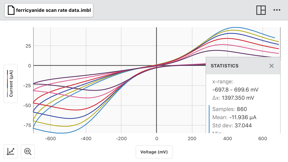
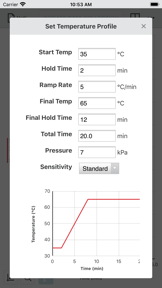

Vernier Instrumental Analysis is a free educational utility for iOS that facilitates data collection from Vernier laboratory instrumentation.
The App DNA
What makes this app unique?
It serves chemistry students and educators who require precise, hardware-verified data for laboratory experiments, a job-to-be-done that general-purpose AI tutors cannot fulfill.
For Chemistry students and educators utilizing Vernier laboratory instrumentation.
What does it look like?
Key features
Enables collection of gas chromatograms from Mini GC series devices with tools for peak area determination and integration.
Supports collection of optical rotation data and polarimetry scans, including monitoring mutarotation kinetics over time.
Allows for the collection of voltammograms to analyze current peaks and determine standard potentials for electrochemical reactions.
How much does it cost?
The app is free to download, functioning as a utility for existing hardware customers.
Velocity
Steady developmentShow more...
Who built it?
Vernier Software & Technology
8 apps tracked · Education
 Vernier Video Physics
 Vernier Graphical Analysis
 Vernier Graphical Analysis GW
 Vernier Spectral Analysis
 Vernier Go Wireless
 LabQuest Viewer
 Vernier Thermal Analysis Plus
User Sentiment
What do users think recently?
How are ratings & reviews evolving?
Not enough recent reviews to extract reliable themes yet.
Read the full review analysisCompetition
Competitive landscape for Vernier Instrumental Analysis
How's the Education market?
Vernier Instrumental Analysis serves a specialized educational niche, relying on hardware-software coupling to maintain relevance in a market increasingly dominated by AI-driven homework tools.
Read the market outlookThe rivals identified

By Utku Gedik
ChemLens competes directly for the student user base by providing AI-driven homework assistance and problem-solving tools that overlap with the educational goals of Vernier's curriculum-focused instrumentation.
- Leverages generative AI for instant tutoring, whereas Vernier relies on manual, hardware-dependent data collection workflows.
- Massive user base and high review volume create a significant social proof barrier for new entrants.
- Camera-based problem scanning offers immediate utility for students compared to Vernier's specialized lab-equipment-only focus.

Unlock the head-to-head verdict: where this rival wins, and where it loses.
Access the full report for freeThe Analyst's Read
Key takeaways for Vernier Instrumental Analysis
Where is it heading?
The chemistry education market is shifting toward AI-assisted homework tools that prioritize accessibility over physical lab precision. Vernier must evolve its software to interpret lab data through an AI lens, or it will lose the student demographic to apps that offer faster, lower-friction study workflows.
- The app maintains a steady utility role for existing hardware owners, but the lack of feature expansion leaves it exposed to AI-driven competitors.
The SWOT
- Proprietary hardware integration provides unmatched data accuracy for physical chemistry experiments
- Specialized instrumentation support creates high switching costs for educators already invested in Vernier laboratory suites
- Integration with mobile-first AI analysis tools could bridge the gap between physical lab data and homework assistance
Next best moves
Integrate AI-assisted data interpretation because ChemLens threatens the user base with instant homework help → maintain relevance for students
The counter-intuitive read
The reliance on physical hardware is not a weakness but a moat…
Read the full takeFeature gaps
AI-driven homework assistance (available in ChemLens but absent here) +1
Since the last report: The report updates the competitive assessment and SWOT analysis to better articulate the threat posed by AI-driven homework tools and the necessity of an AI-assisted data interpretation pivot.
Bottom line
Vernier Instrumental Analysis secures its position through hardware-verified accuracy, but it risks irrelevance as AI tutors capture the student homework market, so the PM must integrate AI-assisted analysis to bridge the gap between lab work and study.
Unlock 2 critical frictions, 1 market threat and the analyst’s take.
Access the full report for freeReport last updated