


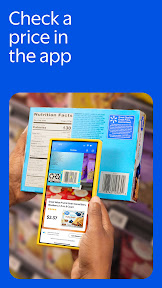


Walmart is a retail shopping app for groceries and household essentials, offering pickup, delivery, and in-store payment tools on iOS and Android.
The App DNA
What makes this app unique?
Users hire the app to consolidate physical store visits and digital grocery orders into a single, membership-gated workflow that saves time and fuel costs.
For Value-conscious shoppers and families seeking to consolidate grocery, pharmacy, and household essentials purchasing.
What does it look like?
Key features
Real-time Q&A, review summaries, and shopping assistance for birthdays and events.
In-store contact-free checkout using the mobile app.
Augmented reality tool to visualize furniture and decor in the user's physical space.
How much does it cost?
Freemium model uses a membership tier to gate convenience features like Scan & Go and fuel discounts.
Velocity
Active developmentopaqueperformanceUX improvementsShow more...
The app maintains an active release cadence of approximately 0.7 releases per week, with updates distributed across both iOS and Android platforms. Despite the frequent updates, the release notes are uniformly opaque, consistently using generic language regarding time and money savings rather than detailing specific feature changes or bug fixes. This pattern suggests the publisher likely utilizes server-side feature flags or A/B testing to manage the user experience rather than relying on App Store changelogs to communicate updates. The development trend remains stable, focusing on continuous, incremental maintenance.
Who built it?
Walmart
13+ apps tracked · Shopping
 Spark Driver
 MyWalmart
 Walmart Pharmacy App
 Walmart Events
 Scintilla In-Store
 Customer Spark
 Walmart Business: B2B Shopping
 Me@Campus
 MyWalmart Experiments
 Walmart Seller
 WMT Events
 Walton Whole Health & Fitness
User Sentiment
What do users think recently?
The recent review mood reads mixed. Users appreciate convenient home delivery services provide essential support for users with limited mobility or time, but report frequent application crashes following the latest update prevent users from accessing their accounts or orders.
How are ratings & reviews evolving?
What users say, by theme
- Convenient home delivery services provide essential support for users with limited mobility or time
- Frequent application crashes following the latest update prevent users from accessing their accounts or orders
100 of 247 recent reviews analyzed · high confidence · Mixed overall
Read the full review analysisUnlock 1 user request, each backed by review evidence.
Access the full report for freeCompetition
Competitive landscape for Walmart: Shopping & Savings
How's the Shopping market?
Walmart sits #26 Free / #5 Category in the US, holding the #26 overall slot for the current period. The gap between discovery and grossing performance signals that the app is a utility for existing shoppers rather than a high-margin conversion engine.
Read the market outlookThe rivals identified

By AMZN Mobile LLC
Amazon Shopping competes for the same general consumer base seeking household essentials, with both apps serving as primary mobile gateways for retail. They overlap in their core utility of browsing and purchasing across multiple product categories.
- Amazon offers Visual Search for product identification; Walmart relies on text-based search and Sparky AI.
- Amazon provides View in Your Room for furniture placement; Walmart uses Home VR.
- Amazon integrates Live Chat Support for service; Walmart lacks a comparable direct-to-agent feature.
 Target: Shop. Style. Save.Contender
 Macy's: Online Shopping & SaveContender
 KrogerContender
 Kohl's - Shopping & DiscountsContender
 Best Buy: Tech Deals & SavingsContender
 GameStopContender
 Five BelowContender
Unlock the head-to-head verdict: where this rival wins, and where it loses.
Access the full report for freeThe Analyst's Read
Key takeaways for Walmart: Shopping & Savings
Where is it heading?
The casual grocery market is consolidating around omnichannel reliability, and Walmart's current stability regression leaves it exposed to digital-first rivals. If the launch-crash loop persists, the brand will lose the high-frequency grocery base that currently sustains its chart position, so the PM must prioritize stability over new feature cadence.
- Frequent launch crashes in the latest version block core shopping, which compounds the rating drag already visible on Android.
- Recent expansion of prescription delivery with no order minimums drives high-frequency utility, which increases customer lifetime value.
The SWOT
- Physical store footprint enables same-day pickup and delivery
- Walmart+ membership creates a recurring revenue lock-in
- Pharmacy integration drives high-frequency session utility
- Expand B2B pharmacy partnerships to increase distribution
- Integrate impulse-buy features into the pickup workflow
- Improve in-store navigation to reduce physical visit friction
Next best moves
Rebuild launch sequence because the current crash-loop blocks core shopping and order tracking → restore retention baseline.
+ 2 more prioritized movesThe counter-intuitive read
The 'AI race' framing misses that Walmart's moat is physical store density…
Read the full takeFeature gaps
Impulse-buy add-ons during pickup (available in Target but absent here) +1
Since the last report: The app's competitive position is currently pressured by severe post-update stability regressions that have shifted sentiment from positive to mixed.
Bottom line
Walmart holds its category lead through sticky physical-digital integration but bleeds users to fulfillment errors and stability regressions, so revenue growth hinges on stabilizing the launch-crash loop before expanding the AI-assisted shopping surface.
Unlock 3 critical frictions, 3 market threats, 2 more prioritized moves and the analyst’s take.
Access the full report for freeReport last updated