


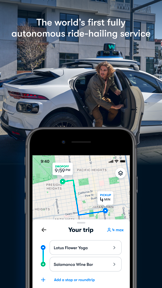
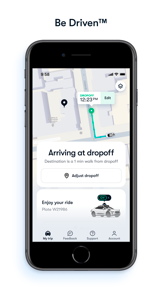
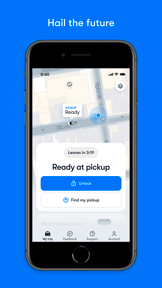

Waymo is an autonomous ride-hailing app for urban residents and travelers, providing on-demand, driverless transportation on iOS and Android.
The App DNA
What makes this app unique?
Users hire Waymo to eliminate the social and safety unpredictability of human drivers, trading a premium price for a consistent, private, and stress-free transit experience.
For Urban residents and travelers in supported territories seeking autonomous, private, and on-demand transportation.
What does it look like?
Key features
Users hail fully autonomous vehicles to specific destinations via the app interface
Displays real-time sensor visualization of the vehicle's surroundings and provides direct access to Rider Support
Automatic vehicle unlocking triggered by proximity via Bluetooth connection
How much does it cost?
Transaction-based model with no subscription requirement, pricing is determined by individual ride requests.
Velocity
Active developmentplatform expansionUX improvementsShow more...
Waymo is currently shipping updates at a cadence of approximately 0.38 releases per week, or roughly one update every 18 days. Development is stable and focused on geographic expansion, with recent updates explicitly detailing new service areas in California. While iOS releases are currently limited to generic maintenance notes, the Android platform provides clear signals of feature-driven growth. The development trend is stable, prioritizing market penetration and service availability.
Who built it?
User Sentiment
What do users think recently?
The recent review mood reads mixed. Users appreciate autonomous navigation provides a relaxing and stress-free alternative to human-operated rideshare services, but report restrictive device security requirements prevent users on custom operating systems from accessing the service.
How are ratings & reviews evolving?
What users say, by theme
- Autonomous navigation provides a relaxing and stress-free alternative to human-operated rideshare services
- Restrictive device security requirements prevent users on custom operating systems from accessing the service
100 of 203 recent reviews analyzed · high confidence · Mixed overall
Read the full review analysisUnlock 1 user request, each backed by review evidence.
Access the full report for freeCompetition
Competitive landscape for Waymo
How's the Travel market?
Waymo holds a #20 Free rank in the US Travel category, supported by a 4.97 rating across 205,778 iOS reviews. The high rating-to-rank ratio signals a loyal user base in existing territories, but the lack of top-tier grossing performance suggests limited penetration against mass-market incumbents.
The rivals identified

By Intelligent Apps GmbH
Both apps compete for the urban commuter segment by offering on-demand ground transportation, though they diverge on the mechanism of delivery: Waymo relies on autonomous safety, while Freenow aggregates multi-modal human-driven transit.
- Freenow integrates e-scooters and public transit into one booking interface; Waymo is strictly autonomous ride-hailing.
- Freenow provides a dedicated B2B corporate portal for enterprise travel; Waymo lacks this business-focused account structure.
- Freenow supports in-app driver chat for human coordination; Waymo relies on automated autonomous navigation.
 ZooxContender
 AltoContender
 Ride FreebeeContender
 Tesla RobotaxiContender
 Verne: Order autonomous ridesContender
 Bliq DriverlessContender
Unlock the head-to-head verdict: where this rival wins, and where it loses.
Access the full report for freeThe Analyst's Read
Key takeaways for Waymo
Where is it heading?
The autonomous ride-hailing market is shifting from pilot-phase testing to broad urban deployment, placing Waymo in a race against purpose-built competitors like Zoox. Waymo's current reliance on retrofitted vehicles provides a short-term safety advantage, but the lack of navigation precision near transit tracks creates a long-term retention risk that will allow rivals to capture the daily-commuter segment if not addressed.
- Recent expansion into Miami, Orlando, and Nashville demonstrates active geographic growth, which increases the total addressable market for the autonomous fleet.
- Navigation failures near transit tracks cause physical strain for passengers, which erodes trust and increases churn pressure in dense urban environments.
The SWOT
- Proven safety record across millions of miles sustains user trust
- All-electric fleet aligns with urban sustainability mandates
- Proprietary sensor suite maintains constant 360-degree visibility
- Expansion into untapped urban neighborhoods
- Integration of in-vehicle charging for long-distance commuters
- B2B partnerships for corporate transit
Next best moves
Audit Android security checks because they block users on custom builds → increase addressable market.
+ 1 more prioritized moveThe counter-intuitive read
Waymo's high rating is a trap: the current premium…
Read the full takeFeature gaps
Multi-modal transit integration (available in Uber but absent here) +1
Since the last report: Waymo's competitive position is under pressure as sentiment shifts to mixed due to navigation errors and device compatibility issues, despite continued aggressive geographic expansion.
Bottom line
Waymo maintains a strong category lead through a superior, stress-free autonomous experience, but navigation errors and pricing friction limit its mass-market appeal, so the PM should prioritize navigation reliability to protect the core commuter base.
Unlock 3 critical frictions, 3 market threats, 1 more prioritized move and the analyst’s take.
Access the full report for freeReport last updated