


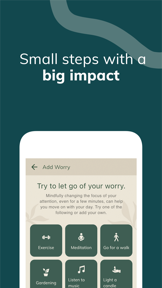


WorryTree is a CBT-based anxiety management app for iOS and Android that provides journaling and sensory grounding tools.
The App DNA
What makes this app unique?
Users hire WorryTree to build new thinking habits through structured problem-solving, serving those who find generic meditation apps insufficient for anxiety relief.
For Individuals experiencing generalized anxiety or overthinking seeking practical, non-clinical self-help tools.
What does it look like?
Key features
Structured journaling tool for recording and managing anxious thoughts.
Guided sensory exercises for immediate anxiety refocusing.
Interactive tool for reframing negative thought patterns.
How much does it cost?
Subscription model gates advanced CBT tools to sustain independent operations.
Velocity
Maintenance developmentperformanceopaqueShow more...
The app is currently in a maintenance phase, shipping only minor stability and background updates. With only two releases identified in the observed data, the cadence is insufficient to suggest active feature development or live operations. The release notes are opaque, providing no insight into specific functional changes or roadmap progression. Development appears focused solely on long-term stability rather than new content or feature expansion.
Who built it?
User Sentiment
What do users think recently?
How are ratings & reviews evolving?
Not enough recent reviews to extract reliable themes yet.
Read the full review analysisCompetition
Competitive landscape for WorryTree: Anxiety Relief
How's the Health & Fitness market?
WorryTree holds a 4.6-star rating on iOS but struggles with a 3.7-star rating on Android, indicating a fragmented user experience. Recent rankings show new grossing entries in European markets, but the app remains outside the top 50 in most regions, signaling limited scale.
Read the market outlookThe rivals identified

By Hae Bum Kim
Tochi directly competes for the same user base seeking mental health management through journaling and mood tracking, mirroring WorryTree's core CBT-based value proposition.
- Offers a life chapters narrative feature that provides deeper long-term emotional context than standard journaling
- Higher review volume and frequency of updates suggest a more established and active user community
- Includes specific mood and trigger logging tools that provide more granular data than WorryTree's current approach
 PBS Data CollectionContender
 Motivity - ABA Data CollectionContender
 Simply PluralContender
 OctoconContender
Unlock the head-to-head verdict: where this rival wins, and where it loses.
Access the full report for freeThe Analyst's Read
Key takeaways for WorryTree: Anxiety Relief
Where is it heading?
The mental wellness market is shifting toward AI-integrated, conversational experiences that lower the barrier to entry for emotional processing. WorryTree's static journaling approach is increasingly exposed, so the team must either bridge the technical gap on Android or pivot toward more interactive, AI-assisted CBT tools to remain competitive.
- The 0.9-star rating gap on Android indicates technical debt that erodes trust, which compounds churn risk as users migrate to more stable alternatives.
- New grossing entries in European markets suggest the brand is gaining visibility, providing a foundation for potential B2B partnership expansion.
The SWOT
- Clinical CBT framework provides a clear value proposition for users seeking evidence-based self-help
- B2B partnerships with GP practices could leverage the app's clinical focus to drive institutional distribution
Next best moves
Audit Android build stability because the 0.9-star rating gap vs iOS indicates technical churn → stabilize rating baseline
The counter-intuitive read
The app's clinical focus is its primary moat…
Read the full takeFeature gaps
Real-time AI emotional processing (available in Aurie but absent here) +1
Since the last report: The analysis shifted focus from general feature development to addressing a critical 0.9-star rating disparity between iOS and Android platforms and the rising threat of conversational AI wellness apps.
Bottom line
WorryTree secures high engagement through its clinical CBT focus, but the technical disparity between iOS and Android platforms risks alienating half the user base, so prioritizing Android stability is essential to protect the subscription funnel.
Unlock 1 critical friction, 1 market threat and the analyst’s take.
Access the full report for freeSources
- [1] App Store, source
Report last updated