





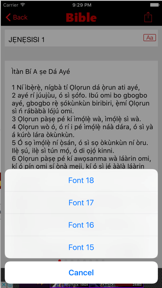

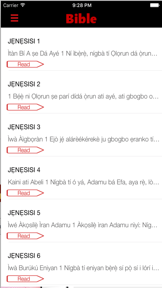
Yoruba Bible is a free, text-only digital Bible app for Yoruba-speaking users on iOS.
The App DNA
What makes this app unique?
Users hire this app for immediate, offline access to the Bible in their native language, serving the need for religious study without the complexity of multi-feature platforms.
For Yoruba-speaking individuals seeking digital access to the Bible in their native language.
What does it look like?
Key features
Full text of the Bible in the Yoruba language, published by the Bible Society of Nigeria
Text-based query tool for locating specific biblical passages within the app
Integration with Facebook and email for sharing verses
How much does it cost?
The app is distributed as a free utility with no visible subscription or IAP gates.
Velocity
Dormant developmentopaqueShow more...
The app has not received a single update in over 112 months, far exceeding the threshold for a zombie classification. The only recorded release was a generic maintenance update provided by Apple, containing no new features. There is no evidence of active development, live operations, or ongoing support for this application.
Who built it?
La Biblia Reina Estudios Teología Cristiana Apps
13+ apps tracked · Book
 La Biblia de las Americas
 Nova Tradução na Linguagem de Hoje Bíblia (Audio)
 Biblia de Estudios Bíblicos
 Nigeria Igbo Bible
 Estudios Bíblicos Profundos
 Temas Bíblicos Predicas
 Setswana Bible
 Η Αγία Γραφή
 Estudos Bíblicos para Mulheres
 Santa Biblia NTV
 Biblia La Torah en Español
 Devocionales Cristianos
User Sentiment
What do users think recently?
How are ratings & reviews evolving?
Not enough recent reviews to extract reliable themes yet.
Read the full review analysisCompetition
Competitive landscape for Yoruba Bible
How's the Book market?
The app occupies a narrow utility niche with a 3.33 rating across 3 reviews. The lack of updates since 2017 signals a stagnant market position that relies solely on organic search for the Yoruba translation.
Read the market outlookThe rivals identified

By JaqerSoft
This app competes directly by offering a specialized, language-specific Bible experience that leverages audio and advanced synchronization features to capture the same religious study demographic.
- Offers bilingual side-by-side reading, which provides significantly more value for language learners and researchers.
- Integrates cloud-based note synchronization, ensuring user data persists across devices unlike this app's local-only storage.
- Provides high-fidelity audio Bible playback, a major engagement driver missing from this app's feature set.
 9,456 Bible Encyclopedia EasyContender
 59 Bible TimelinesContender
 68 Mega Bibles EasyContender
 Bengali English Audio BibleContender
Unlock the head-to-head verdict: where this rival wins, and where it loses.
Access the full report for freeThe Analyst's Read
Key takeaways for Yoruba Bible
Where is it heading?
The religious study market is consolidating around apps that offer multi-modal content, such as audio and cross-referencing. This app's static posture leaves it exposed to more active rivals, so the PM must pivot to feature parity to remain relevant.
- The lack of development activity since 2017 leaves the app vulnerable to competitors that offer modern study features like audio and cloud sync.
The SWOT
- Focused, ad-free interface lowers barrier to entry for non-technical users
- Official Bible Society of Nigeria translation provides high-trust content
- Integrate audio-text synchronization to match emerging study tools
- Partner with local churches for B2B distribution
Next best moves
Ship audio playback support because competitors like Mongolian English Audio Bible use it to drive retention → increase daily active usage
The counter-intuitive read
The app's lack of updates is not just…
Read the full takeFeature gaps
Offline audio playback (available in Mongolian English Audio Bible) +2
Since the last report: The app remains in a stagnant, maintenance-mode state, but the analytical framing has evolved to recognize its minimalist, ad-free nature as a potential competitive defense.
Bottom line
The app provides essential access to the Yoruba Bible but lacks the engagement loops of modern competitors, so the PM should prioritize audio integration to prevent further user churn to feature-rich alternatives.
Unlock 3 critical frictions, 2 market threats and the analyst’s take.
Access the full report for freeReport last updated