



AudioKit Retro Piano is a sample-based vintage piano instrument for iOS, offering standalone performance and AUv3 plug-in support for mobile producers.
The App DNA
What makes this app unique?
It removes the storage and processing friction of high-fidelity piano instruments, allowing musicians to access lo-fi, nostalgic textures on mobile hardware.
For Mobile musicians and producers seeking lo-fi, nostalgic, or retro piano textures for their compositions.
What does it look like?
Key features
Combines vintage piano samples with synth pads for layered, expressive sound design.
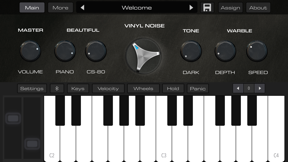
Includes adjustable vinyl noise, warble speed, and depth controls to achieve a sampled, lo-fi aesthetic.
Functions as both a standalone app and an AUv3 plug-in for integration with iOS music hosts.
How much does it cost?
The subscription model creates friction given the app's reliance on free source code, leading to user complaints.
Velocity
Steady developmentShow more...
Who built it?
Audiobus Pty
9 apps tracked · Music
 Audiobus: Mixer for Music Apps
 AudioKit FM Player 2: DX Synth
 Metronome Tracker & Tuner
 LE01 | Bass 808 Synth + AUv3
 VHS Synth | 80s Synthwave
 LE05: Digitalism 2000 + AUv3
 Audiobus Remote
 AudioKit Digital D1 Synth
User Sentiment
What do users think recently?
The recent review mood reads excited. Users appreciate authentic lo-fi aesthetic, but report monetization friction.
How are ratings & reviews evolving?
What users say, by theme
- Authentic lo-fi aesthetic
- Monetization friction
Competition
Competitive landscape for AudioKit Retro Piano
How's the Music market?
AudioKit Retro Piano occupies a niche in the iOS music category, maintaining a 4.24 rating across 156 reviews. The absence of store updates for 535 days indicates a stagnant market position compared to active rivals.
Read the market outlookThe rivals identified

By Suno, Inc.
Suno competes by shifting the user from manual instrument performance to generative AI composition, capturing the same creative music-making audience.
- Offers full generative AI song creation versus target's manual, sample-based piano performance approach.
- Provides commercial usage rights for generated tracks, a major draw for professional content creators.
- Features integrated stem separation, allowing users to isolate and manipulate individual elements of their music.
 eSPiContender
 Battlestation GrooveboxContender
 Neo-Soul Keys® Studio 2Contender
 AI Music & Song Generator *Contender
Unlock the head-to-head verdict: where this rival wins, and where it loses.
Access the full report for freeThe Analyst's Read
Key takeaways for AudioKit Retro Piano
Where is it heading?
The mobile music market is consolidating around generative AI and high-frequency update cadences, leaving AudioKit Retro Piano exposed. Without a shift to one-time pricing or a resumption of feature development, the app will likely see continued erosion of its user base to more active competitors.
- The 535-day update gap indicates a maintenance-only posture, which leaves the app vulnerable to rivals with active feature expansion cycles.
- Subscription friction in user reviews suggests that the current monetization model is misaligned with the app's open-source foundation, limiting growth.
The SWOT
- 50MB sample compression enables pro-grade sound on older hardware
- AUv3 plug-in support allows integration into professional iOS music hosts
- Introduce a one-time purchase option to convert users who reject the subscription model
- Expand the vinyl noise library to further differentiate from generic lo-fi sample packs
Next best moves
Introduce a one-time purchase option because subscription friction is the top complaint → increase conversion of price-sensitive users
+ 1 more prioritized moveThe counter-intuitive read
The app's lack of updates is its most significant retention risk…
Read the full takeFeature gaps
Generative AI composition (available in Suno but absent here) +2
Since the last report: The app's competitive posture has shifted from passive observation to active risk management, as the 535-day update gap now triggers specific warnings regarding technical obsolescence and OS-level breakage.
Bottom line
AudioKit Retro Piano relies on its lightweight AUv3 architecture to retain mobile producers, but the subscription model and lack of updates erode its competitive standing. Transitioning to a one-time purchase model would address the primary user complaint and unlock conversion potential.
Unlock 2 critical frictions, 2 market threats, 1 more prioritized move and the analyst’s take.
Access the full report for freeFAQ
Is AudioKit Retro Piano good for beginners?
How does AudioKit Retro Piano compare to Suno?
Does AudioKit Retro Piano have a one-time purchase option?
What is a free alternative to AudioKit Retro Piano?
Sources
- [1] App Store, source
Report last updated