


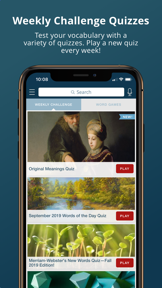


Merriam-Webster Dictionary is the leading authoritative English reference app on iOS, leveraging a high-trust brand heritage to serve students and educators. It distinguishes itself through scholarly reliability, human-voiced audio, and a successful gamification strategy featuring Quordle and Blossom. Currently ranked #45 Free and #78 Grossing in its category, it maintains an excellent 4.8-star rating but faces pressure from digital-native competitors and user frustration regarding ad density.
The App DNA
What makes this app unique?
For Students, educators, and language enthusiasts seeking authoritative, scholarly English language reference tools and vocabulary enrichment.
What does it look like?
Key features
200,000+ word choices with contextual usage examples.
Interactive vocabulary building through Quordle, Blossom, and spelling quizzes.
Human-voiced pronunciations rather than synthetic text-to-speech.
Quick access to Word of the Day and voice-enabled definitions on wearables.
Full access to definitions and synonyms without an internet connection.
How much does it cost?
Leverages high brand trust to maintain a massive free user base, monetizing through high-volume display ads while upselling specialized professional content and ad-removal.
Velocity
Who built it?
Merriam-Webster
8 apps tracked · Reference
 Merriam-Webster Dictionary+
 SCRABBLE Dictionary
 Learner's Dictionary - English
 Quizzitive – A Merriam-Webster Word Game
 Learner's Dictionary - English HD
 Dictionary - Merriam-Webster
 RhymeZone
User Sentiment
What do users think recently?
Recent user voice shows a thrilled sentiment. Users appreciate educational utility and engaging features, but report excessive advertising.
How are ratings & reviews evolving?
What users say, by theme
- Educational Utility
- Engaging Features
Unlock 1 more frustration theme, each backed by review evidence.
Access the full report for freeCompetition
Competitive landscape for Merriam-Webster Dictionary
How's the Reference market?
The rivals identified

By MobiSystems, Inc.
Both apps target students and professionals with authoritative English reference tools, competing directly for daily lookup utility and ad-supported revenue.
- Oxford provides a 15-dictionary aggregator, while Merriam-Webster focuses on a single authoritative lexicon.
- Merriam-Webster includes integrated word games like Quordle and Blossom, which Oxford lacks.
 WikipediaContender
 Dictionary.com: English WordsContender
 Power ThesaurusContender
 Pocket ThesaurusContender
 Cambridge English–RussianContender
 LDOCE (InApp)Contender
 LookUp: English DictionaryContender
 Roget's II: New ThesaurusContender

Unlock the head-to-head verdict: where this rival wins, and where it loses.
Access the full report for freeThe Analyst's Read
Key takeaways for Merriam-Webster Dictionary
Where is it heading?
- Maintains an excellent 4.8 rating with over 315k reviews, indicating deep user loyalty.
- Recent updates (April 2026) focused on maintenance and word updates rather than new feature expansion.
- Rankings show a slight decline (↓3) in both Free and Grossing charts, suggesting increased competitive pressure.
The SWOT
- High-trust brand authority and scholarly reliability
- Superior human-voiced audio pronunciations
- Strong user retention via integrated games (Quordle, Blossom)
- Comprehensive offline capabilities
- Incorporate modern slang and internet terminology to counter Dictionary.com
- Adopt AI-driven contextual learning like WordUp's video clips
- Expand ESL features for the global academic market
Next best moves
Optimize Ad Frequency and Placement
+ 2 more prioritized movesFeature gaps
Slang and Emoji Dictionaries (available in Dictionary.com) +4
Since the last report: The app has solidified its gamification strategy and wearable presence while struggling to resolve long-standing user complaints regarding ad density and search functionality.
Bottom line
Merriam-Webster is the scholarly incumbent with a powerful gamification engine, but it is currently over-leveraging its ad-based monetization at the expense of user experience. To maintain its lead against Dictionary.com, it must fix core search stability and modernize its lexicon to include digital-first terminology without losing its authoritative voice.
Unlock 3 critical frictions, 3 market threats, 2 more prioritized moves and the analyst’s take.
Access the full report for freeReport last updated