


Merriam-Webster
For students, educators, and language enthusiasts requiring scholarly reliability and professional-grade vocabulary resources.
 Dictionary - Merriam-Webster







Snapshot
Who is Merriam-Webster?
Providing authoritative English language reference and vocabulary tools for students, educators, and word enthusiasts.
Target audience


Portfolio
Free 3Last updated

Dictionary - Merriam-Webster
v5.6.2
3mo ago
Publisher DNA
What defines Merriam-Webster?
Publisher DNA
Primary focus
Authoritative English language reference and vocabulary tools
Scale
indie
Target audience
Students, educators, and language enthusiasts requiring scholarly reliability and professional-grade vocabulary resources.
Origin
Established in 1828 and currently operating as an Encyclopædia Britannica Company.
Portfolio momentum
Released 4 updates across 2 active apps in the last 6 months, focusing development resources on the flagship dictionary products.
Company profile
medium confidence- Founded
- 1828
Portfolio
What does Merriam-Webster ship?
Apps
8 apps analysed
Analysis in progress

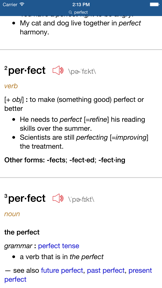
Superior learner-specific content (160k usage examples)
- Content Quality
- Lack of Updates/Compatibility

Specialized ESL pedagogical features (Noun labeling)
- Content Quality
- Lack of Landscape Support

Superior human-voiced audio pronunciations
- Educational Utility
- Excessive Advertising

Human-voiced audio pronunciations
- Educational Value and Content
- Technical Bugs and Crashes
Distributed across 7 markets, strongest in Americas.
Based on 6 of 8 apps with localized market data, more coverage rolling in as scans complete · last scanned .
Americas (3)
- United States6 / 6
- Brazil1 / 6
- Mexico1 / 6
Europe (2)
- Portugal1 / 6
- Spain1 / 6
Asia-Pacific (2)
- Japan1 / 6
- South Korea1 / 6
Core markets (6/6 apps)
User Sentiment
How do users feel about their apps?
4
Positive apps
1
Neutral / mixed
2
Negative apps
59/100
Avg sentiment score
Unlock the app dragging this portfolio down.
Access the full report for freeRivals
Who does Merriam-Webster compete with?
The rivals identified
Nemeses(4)

Both apps target students and professionals with authoritative English reference tools, competing directly for daily lookup utility and ad-supported revenue.


Provides a deep pedagogical reference for Spanish-English learners, acting as a specialized alternative to general English dictionaries.


Targets the same vocabulary-building audience as Merriam-Webster through daily, bite-sized learning sessions.


Both applications target word game enthusiasts by providing word validity checks and point calculations for competitive play.
Contenders(25)


Both apps target students and writers needing offline vocabulary tools, with direct overlap in synonym and antonym lookup functionality.


Competes on brand authority and academic depth, providing a high-quality reference alternative for serious students.


LDOCE competes by targeting advanced English learners with a corpus-based dictionary, directly overlapping with the educational utility provided by Merriam-Webster.


Competes directly as a multi-source reference aggregator that users often compare against Merriam-Webster for definition breadth.


Provides a gamified study path for standardized test preparation, appealing to students who use Merriam-Webster for academic support.


Acts as a high-utility reference tool that provides deep lexical relationships for writers and students.


Thesaurus App - Free competes by providing a dedicated synonym lookup tool, which overlaps with the core thesaurus functionality of Merriam-Webster Dictionary.


Power Thesaurus competes for the same audience of writers and students by offering a specialized focus on synonyms and antonyms, directly overlapping with the integrated thesaurus feature in Merriam-Webster.


Focuses on daily vocabulary enrichment, serving as a secondary tool for users who want to expand their lexicon.


known for Cambridge English Dictionary
Serves the same exam-prep audience by providing specialized thesaurus and dictionary content for international proficiency tests.


Provides a focused American English reference tool for exam-prep students who require specific collocation data.


Both apps compete for the same information-seeking audience within the reference category, forcing users to choose between a scholarly dictionary and a community-governed encyclopedia for their daily research needs.


Provides a bilingual reference alternative for users needing offline translation between English and Farsi.


Serves as a specialized reference for word origins, appealing to the same scholarly audience as Merriam-Webster.


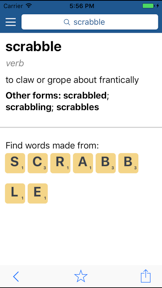
Both apps target Scrabble players requiring word validation and scoring during gameplay. They compete directly for the same user base seeking to verify word eligibility for tournament or casual play.


Both apps compete for the same English language reference intent, targeting users who require dictionary and thesaurus tools for word exploration.


Both apps target users focused on vocabulary building, with Merriam-Webster providing authoritative reference content and Vocab Word offering gamified, self-paced learning tools.


Howjsay English Pronunciation competes for the audio-focused segment of the Merriam-Webster Dictionary+ user base by offering a specialized pronunciation library that overlaps with the core human-voiced audio feature.


Both apps target students and language learners requiring offline reference tools, creating competition for users seeking portable vocabulary resources.


Both apps target competitive word game players needing tournament-standard word verification. Word Check directly challenges the target by offering updated 2023 and 2024 word lists, whereas the target remains stuck on older databases.


Focuses on bite-sized learning for vocabulary, idioms, and phrasal verbs using a notification-based approach.
Differentiators
- Strong presence in the ESL (English as a Second Language) market
- Effective use of push notifications to drive daily active usage


Both applications target English language learners seeking academic reference tools, competing directly for users requiring dictionary content for study and instruction.


ULU targets the same competitive word game audience by offering both North American and international lexicons for free, directly challenging the paid and outdated SCRABBLE Dictionary.


Both apps compete for the same student and language learner demographic by offering freemium dictionary tools and vocabulary enrichment features.


Both apps target competitive word game players needing official word validation, with Scrabble Words directly challenging the official reference tool by offering current tournament word lists including CSW24 and NWL23.
Same space(33)


Provides specialized word tools like rhyming and synonym search that complement standard dictionary lookups.


Provides a structured, science-based path for vocabulary growth that competes with Merriam-Webster's educational features.


Offers an AI-driven approach to vocabulary mastery that appeals to users seeking personalized study methods.


Acts as a niche language-learning companion that provides specialized dictionary and character recognition tools for Chinese learners.


Targets the same privacy-conscious user base by offering an offline-first, ad-free reference experience.


This app combines dictionary lookups with translation, serving users who need to bridge language gaps while building vocabulary.


Serves as a specialized reference tool for bird identification that competes for user attention during outdoor activities.


This app serves the same learning audience as Merriam-Webster but relies on academic databases like WordNet for its definitions.


Serves the same professional user base as RhymeZone by providing high-accuracy linguistic tools for creative and technical writing.


This app fills a niche for idioms and slang that Merriam-Webster's formal dictionary may not prioritize for language learners.


Focuses on high-frequency vocabulary building through spaced repetition, competing for the same educational user base.


Targets the same vocabulary-building audience as RhymeZone by offering a simple interface for finding synonyms.


Captures the daily-devotional market through push notifications, competing for the same daily-habit user base as Merriam-Webster.


Offers a specialized utility for word game enthusiasts that relies on official game word lists.


While not a dictionary, it is the primary tool learners use for real-time English correction and vocabulary enhancement.
Differentiators
- Leader in consumer-facing AI linguistic technology
- Massive capital and R&D resources focused on natural language processing


This app provides a simple, fast dictionary alternative for users who find Merriam-Webster's interface too complex or slow.


Offers a similar reference utility but shifts the monetization model toward ad-supported access.


This app provides a lightweight, multilingual viewer for Wiktionary content, serving users who prefer open-source data over proprietary dictionaries.


Integrates directly into the keyboard to provide synonym suggestions while writing, serving the same creative workflow as RhymeZone.


Focuses on daily vocabulary growth for professionals and students, acting as a supplement to reference apps.


Functions as a specialized offline field guide that replaces physical books for birding enthusiasts.


Targets professional ornithologists with high-authority content, acting as a premium alternative to free reference apps.


Provides a localized, bilingual reference experience for specific language groups learning English.


Targets the same academic audience but emphasizes corpus-based examples over the source app's static dictionary entries.


This app acts as a pronunciation-focused companion to Merriam-Webster for users needing multi-language audio support.


Provides a basic, offline-first reference tool for users who prioritize simplicity over advanced features.


This app offers a visual approach to word connections, serving users who prefer graphical exploration over standard list-based dictionary interfaces.


Provides a general-purpose reference tool for learners who need a free, offline-capable dictionary and thesaurus.


Targets users interested in informal communication and idioms, serving as a specialized supplement to standard dictionary definitions.


While a broad brain-training app, its 'Brevity', 'Context', and 'Error Avoidance' games compete directly for the intellectual vocabulary audience.
Differentiators
- Apple's App of the Year pedigree with high brand recognition
- Proven monetization through a high-value subscription model


This app competes with Merriam-Webster by offering a completely ad-free, zero-monetization utility for users who dislike paid or ad-supported models.


This app provides a bilingual dictionary and translation tool based on Wiktionary, serving users who need both definition and translation.


Competes as a lightweight, offline-first reference tool that prioritizes performance over the source app's legacy features.
New entrants(3)


Encourages daily vocabulary building through short sessions and streaks, competing for the same habit-forming user base.


Focuses on calm, habit-based vocabulary building for writers and thoughtful communicators.


Maps vocabulary in two dimensions, providing a unique visualization tool for users exploring nuance and intensity.
Frequently asked questions
How many apps does Merriam-Webster publish?
What kind of apps does Merriam-Webster make?
What is Merriam-Webster's top app?
In how many countries are Merriam-Webster's apps available?
What fed this analysis
- Apps analyzed:
- 7
- With full intel:
- 7
- With overview:
- 7
- Website scraped:
- yes
- Social presence:
- yes
