


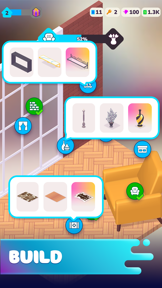


Life Dream is a house design and city-building simulator for casual gamers on iOS and Android.
The App DNA
What makes this app unique?
Users hire the app for a low-pressure creative escape, seeking the satisfaction of home renovation without the real-world stress or time constraints.
For Casual gamers and social media users interested in DIY, home renovation, and interior design content.
What does it look like?
Key features
Granular editing of furniture, plants, and wallpaper within individual rooms
Interactive tasks including stain removal and physics-based object placement
Progression from single-room renovation to city-wide property development
How much does it cost?
Hybrid-casual model utilizing ad-supported gameplay and IAP for cosmetic progression.
Velocity
Maintenance developmentperformanceopaqueShow more...
The app maintains a maintenance-level cadence, averaging approximately 0.23 releases per week over the last three months. Development is exclusively focused on technical stability, bug fixes, and performance optimizations, with no evidence of new content or feature expansion. The release notes are consistently opaque, suggesting that updates are limited to maintenance rather than active feature development or live-ops events. The development trend is stable but strictly limited to infrastructure upkeep.
Who built it?
SayGames
13+ apps tracked · Games
 Little Farm Story: Idle Tycoon
 Last Stronghold: Idle Survival
 Tower War - Tactical Conquest
 Monster Demolition - Giants 3D
 States Builder: Trade Empire
 Color Slide - Hexa Puzzle
 My Sticker Room - Decor Game
 Zoo - Happy Animals
 Wasteland Life: Survival Idle
 Stealth Master: Assassin Ninja
 Black Deck - Card Battle TCG
 Vehicle Masters
User Sentiment
What do users think recently?
Fresh user feedback skews mixed. Users appreciate relaxing and aesthetic room renovation gameplay provides a satisfying escape for stressed users, but report aggressive ad frequency and forced monetization pressure disrupt the flow of the game.
How are ratings & reviews evolving?
What users say, by theme
- Relaxing and aesthetic room renovation gameplay provides a satisfying escape for stressed users
- Aggressive ad frequency and forced monetization pressure disrupt the flow of the game
100 of 103 recent reviews analyzed · high confidence · Mixed overall
Read the full review analysisUnlock 1 user request, each backed by review evidence.
Access the full report for freeCompetition
Competitive landscape for Life Dream: Build Cozy Home
How's the Games market?
Life Dream maintains a 4.5-star rating across 35,300 Android reviews, positioning it as a mid-tier simulator. The lack of a competitive social layer differentiates it from incumbents like Redecor, but limits its ability to capture high-intent design enthusiasts.
Read the market outlookThe rivals identified

By Reworks
Redecor operates in the exact same 'design-and-renovate' niche with a high-velocity release cadence that directly challenges our content-driven engagement model.
- High-frequency content updates with 17 releases in six months drive constant aesthetic variety for users.
- Advanced photorealistic rendering engine creates a more professional design output compared to our stylized approach.
- Live design challenges provide a competitive social layer that our current simulator lacks.
 Design Home™: House MakeoverContender
 Property Brothers Home DesignContender
 Home Design MakeoverContender
Unlock the head-to-head verdict: where this rival wins, and where it loses.
Access the full report for freeThe Analyst's Read
Key takeaways for Life Dream: Build Cozy Home
Where is it heading?
The casual renovation market is consolidating around high-velocity content updates and hybrid-mechanic loops. Life Dream remains exposed due to its reliance on aggressive ad-monetization and lack of item persistence, which will likely accelerate churn as competitors like DesignVille continue to iterate on their multi-layered progression models.
- Technical instability during ad playback creates a negative feedback loop, causing session abandonment and eroding the daily active habit.
- The core renovation loop remains a strong retention driver for casual users who value the relaxing, non-timed design environment.
The SWOT
- Broad city-level progression scope [Market Segment]
- Tactile DIY interaction loops [Retention]
- Low-pressure aesthetic positioning [User Habit]
- Stylus integration for precision [Accessibility]
- Expanded content rotation [Long-term Retention]
- B2B education partnerships [Distribution]
Next best moves
Ship stylus support for room renovation tasks because users report precision issues → improve accessibility and satisfaction
+ 1 more prioritized moveThe counter-intuitive read
The lack of competitive social features is a strength, not a weakness…
Read the full takeFeature gaps
Live design challenges (available in Redecor but missing here) +1
Since the last report: The app has entered a maintenance phase characterized by stagnant feature development and rising user frustration over monetization and technical performance.
Bottom line
Life Dream succeeds by offering a low-pressure design sandbox, but it risks long-term retention due to aggressive ad-monetization and technical instability, so the PM should prioritize ad-frequency optimization and item persistence to stabilize the user base.
Unlock 3 critical frictions, 3 market threats, 1 more prioritized move and the analyst’s take.
Access the full report for freeReport last updated