


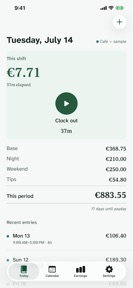




Ora is a shift and earnings tracker for hourly employees, available on iOS as a one-time purchase utility.
The App DNA
What makes this app unique?
Workers use Ora to remove the cognitive and time cost of calculating complex pay structures manually, providing a reliable audit trail against employer payslips.
For Hourly workers and shift-based employees who need to track complex pay structures and verify earnings against employer records.
What does it look like?
Key features
Calculates earnings for overnight shifts, overtime, and holiday multipliers with a higher-rate-wins rule.
Displays real-time earnings progress on the lock screen during active shifts.
Backs up shift data to personal iCloud storage, increasing switching costs.
How much does it cost?
Monetization relies on a single one-time purchase model to unlock advanced features, avoiding recurring subscription costs.
Velocity
Maintenance developmentUX improvementsmonetizationShow more...
With two releases in the last three days, the app is currently in a maintenance phase relative to the 6-month window. The latest release introduced refined branding and subscription management, while the previous version lacked descriptive notes. Development appears focused on stability and core utility refinements rather than rapid feature expansion. The current cadence reflects a stable, low-frequency update pattern.
Who built it?
Mihaly Marcell Gyori
2 apps tracked · Business
 Savy's Soccer Predictions
User Sentiment
What do users think recently?
How are ratings & reviews evolving?
Not enough recent reviews to extract reliable themes yet.
Read the full review analysisCompetition
Competitive landscape for Ora: Shift & Earnings Tracker
How's the Business market?
Ora positions itself as a privacy-first alternative in the Business category, utilizing a one-time purchase model to differentiate from subscription-based rivals.
Read the market outlookThe rivals identified
Unlock the deeper market read.
Access the full report for freeThe Analyst's Read
Key takeaways for Ora: Shift & Earnings Tracker
Where is it heading?
The shift-tracking market is moving toward deeper integration with employer payroll systems, which places manual trackers like Ora at a disadvantage. Ora must emphasize its privacy and audit-trail utility to retain users who prioritize data ownership over automated convenience.
- The latest release focuses on brand identity and subscription management, signaling active maintenance and refinement of the core value proposition.
The SWOT
- One-time purchase model lowers long-term cost barriers.
- Privacy-first design via local iCloud storage.
- Specialized math engine handles complex shift rules.
- Develop employer-specific templates to speed up setup.
- Introduce referral loops to drive organic growth.
Next best moves
Ship employer-specific templates because manual setup is a primary friction point for new users → increase conversion rate.
+ 1 more prioritized moveThe counter-intuitive read
Users report: The one-time purchase model is a retention lever…
Read the full takeSince the last report: Ora transitioned its strategic focus from privacy-based differentiation to mitigating the competitive disadvantage of manual data entry. The developer now prioritizes employer-specific templates to counter the rise of automated payroll-integrated alternatives.
Bottom line
Focusing on the reliability of the shift-math engine will solidify Ora's position as the primary audit tool for hourly workers, as long as the manual entry friction does not drive users toward automated payroll alternatives.
Unlock 2 critical frictions, 2 market threats, 1 more prioritized move and the analyst’s take.
Access the full report for freeFAQ
Is Ora suitable for tracking multiple jobs?
Does Ora provide tax or legal advice?
What is the difference between the free and paid versions?
Sources
- [1] App Store, source
Report last updated