

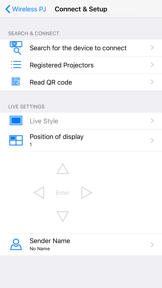


Panasonic Wireless Projector is a free utility for iOS devices that enables wireless projection of documents and web content to compatible Panasonic displays.
The App DNA
What makes this app unique?
Users hire this app to bridge the gap between mobile content and professional display hardware, ensuring that Panasonic projector owners have a native, zero-cost path for presentations.
For Business professionals and educators using Panasonic wireless-compatible projectors for presentations.
What does it look like?
Key features
Transmits PDF, PowerPoint, and images from mobile devices to Panasonic hardware.
Projects live websites directly from the mobile interface.
Supports pinch-to-zoom, rotation, and page flicking.
How much does it cost?
The app functions as a zero-cost utility to support Panasonic hardware sales, with no in-app purchases or subscription gates.
Velocity
Dormant developmentopaqueShow more...
The app has been inactive for over six years, with no updates recorded since May 2020. Given the lack of development activity for well over 12 months, the app is classified as a zombie. There is no evidence of ongoing maintenance, feature development, or live operations.
Who built it?
Panasonic Connect Co.
6 apps tracked · Productivity
 Smart Projector Control
 Video Intercom
 Home Network System
 Video Intercom
 Panasonic MobileSoftphone
User Sentiment
What do users think recently?
How are ratings & reviews evolving?
Not enough recent reviews to extract reliable themes yet.
Read the full review analysisCompetition
Competitive landscape for Panasonic Wireless Projector
How's the Productivity market?
The app functions as a legacy utility with a 2.33 rating across 3 reviews, signaling that its value is tethered strictly to hardware ownership rather than software quality.
Read the market outlookThe rivals identified

By Vysor, Inc.
Vysor competes directly by offering robust screen mirroring and remote control capabilities that overlap with Panasonic's wireless projection utility.
- Provides full remote control of mobile devices, whereas Panasonic is limited to one-way content projection.
- Cross-platform desktop support allows users to mirror mobile screens to any computer, not just projectors.
- High-frequency user engagement through screen sharing features creates a stronger network effect than projection-only tools.




Unlock the head-to-head verdict: where this rival wins, and where it loses.
Access the full report for freeThe Analyst's Read
Key takeaways for Panasonic Wireless Projector
Where is it heading?
The market for wireless projection is shifting toward cross-platform, high-versatility tools that offer more than simple content mirroring. Panasonic's reliance on a legacy, mobile-only utility leaves it exposed to churn, so the PM must decide whether to modernize the software or transition to a web-based standard to avoid further rating erosion.
- The lack of updates since 2020 indicates the app is in maintenance mode, which prevents it from keeping pace with modern connectivity standards.
- The 2.33 rating suggests that the current user experience is failing to meet expectations, which likely drives users toward more reliable third-party alternatives.
The SWOT
- Native integration with Panasonic hardware ensures optimized latency
- Zero-cost barrier for existing Panasonic hardware owners
- Integration of remote annotation tools
- Expansion into cross-platform desktop support
Next best moves
Audit legacy connectivity protocols because the 2.33 rating indicates significant user frustration → stabilize the core projection experience.
+ 1 more prioritized moveThe counter-intuitive read
The app's lack of updates is not a…
Read the full takeFeature gaps
Full remote device control (available in Vysor but absent here) +2
Since the last report: The intelligence profile shifted from viewing the app as a legacy utility to identifying it as a candidate for sunsetting due to persistent connectivity issues and superior cross-platform competition.
Bottom line
Panasonic Wireless Projector maintains hardware sales through native integration, but its lack of updates and poor rating leave it vulnerable to modern, cross-platform rivals, so the PM should pivot toward a web-based projection standard to reduce mobile-specific maintenance costs.
Unlock 3 critical frictions, 3 market threats, 1 more prioritized move and the analyst’s take.
Access the full report for freeReport last updated