




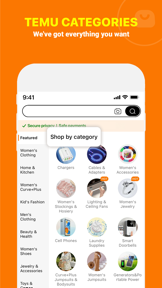


Temu is a global shopping marketplace for fashion, home, and lifestyle goods, structured around factory-direct pricing on iOS and Android.
The App DNA
What makes this app unique?
Shoppers use Temu to access low-cost household items that displace traditional local retail, removing the financial cost of standard retail markups.
For Value-conscious consumers seeking a wide variety of discounted household, fashion, and lifestyle goods.
What does it look like?
Key features
Time-limited price reductions on specific inventory items, serving as a primary conversion driver.
Free returns and refunds for items within 90 days, mitigating buyer risk.
How much does it cost?
Monetization relies on high-volume transaction fees and marketplace activity rather than subscription gates.
Velocity
Active developmentopaqueUX improvementsShow more...
The app maintains an active release cadence of approximately 0.5 releases per week, with updates occurring roughly every 10-14 days. Despite the consistent frequency, the release notes are uniformly generic, providing no insight into specific feature additions or technical improvements. This pattern is consistent with apps that utilize server-side A/B testing and feature flags to manage the user experience. Development appears stable, focusing on continuous iteration rather than infrequent, large-scale version deployments.
Who built it?


User Sentiment
What do users think recently?
Users report: The recent review mood reads frustrated. Users appreciate low prices on household goods and tools provide significant value for budget-conscious shoppers and responsive refund and return policies allow users to recover funds quickly when items arrive damaged, but report deceptive promotional games and free gift offers pressure users into making unnecessary purchases.
How are ratings & reviews evolving?
Weekly average review rating
What users say, by theme
- Low prices on household goods and tools provide significant value for budget-conscious shoppers
- Responsive refund and return policies allow users to recover funds quickly when items arrive damaged
- Users report: Deceptive promotional games and free gift offers pressure users into making unnecessary purchases
120 of 49917 recent reviews analyzed · high confidence · Frustrated overall
Read the full review analysisUnlock 2 more frustration themes and 1 user request, each backed by review evidence.
Access the full report for freeCompetition
Competitive landscape for Temu: Shop Like a Billionaire
How's the Shopping market?
Temu holds the #1 or #2 shopping category position in over 30 countries, including the US and Brazil. This rapid acquisition velocity contrasts with a 35/100 sentiment score, indicating that aggressive growth tactics currently outweigh long-term user satisfaction.
Read the market outlookThe rivals identified

By Roadget Business PTE. LTD.
Both platforms target budget-conscious consumers with factory-direct pricing and frequent flash sales, creating direct competition for the same impulse-driven shopping demographic.
- SHEIN integrates real-time community engagement features, whereas Temu focuses on individual gamified reward loops.
- SHEIN maintains a fashion-first inventory focus, while Temu offers a broader general merchandise catalog.
 AliExpress - Shopping AppContender
 Joom. Shopping for every dayContender
 Fashion Nova: Trendy ShoppingContender
 Voghion - Online shopping appContender
 Taobao - Online Shopping AppContender
Unlock the head-to-head verdict: where this rival wins, and where it loses.
Access the full report for freeThe Analyst's Read
Key takeaways for Temu: Shop Like a Billionaire
Where is it heading?
The global shopping market is consolidating around service-level guarantees, as evidenced by the success of the AliExpress Choice program. Temu's current reliance on gamified traps leaves it exposed to rivals that offer better delivery reliability, suggesting that the current acquisition-heavy posture will face compression by Q3.
- Users report: High-frequency complaints regarding deceptive promotional games erode user trust, which compounds the churn pressure from poor product quality control.
- The 90-day return policy remains a strong retention anchor, providing a clear risk-mitigation mechanism that keeps budget-conscious users returning despite quality issues.
The SWOT
- 90-day return policy mitigates buyer risk
- Factory-direct pricing undercuts local retail
- Integrating live-streamed discovery would reduce churn
Next best moves
Deprecate mandatory promotional mini-games because they are the #1 complaint theme → improve user sentiment
+ 1 more prioritized moveThe counter-intuitive read
Temu's aggressive marketing is not a bug but a feature…
Read the full takeFeature gaps
Direct seller chat (available in AliExpress) +1
Since the last report: The platform's outlook shifted from mixed to declining as the sentiment score fell from 35 to 25, driven by intensifying user backlash against manipulative promotional games and aggressive marketing tactics.
Bottom line
Temu's factory-direct pricing model secures massive market share, but the reliance on manipulative promotional games creates a churn-inducing experience that threatens long-term retention. Pivoting toward a cleaner, quality-focused browsing experience would unlock sustainable growth beyond the initial acquisition phase.
Unlock 2 critical frictions, 1 market threat, 1 more prioritized move and the analyst’s take.
Access the full report for freeFAQ
Is Temu safe for first-time shoppers?
How does Temu compare to AliExpress?
What is a good alternative to Temu?
Sources
Report last updated