


VoiceTra
By NICT
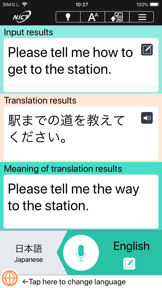


VoiceTra is a free speech translation app for international travelers, providing two-way communication in 33 languages on iOS.
The App DNA
What makes this app unique?
Users hire VoiceTra for accurate, context-aware speech translation during travel, avoiding the literal-translation errors common in generic tools.
For International travelers and individuals requiring basic speech translation for transit, shopping, or hotel interactions.
What does it look like?
Key features
Translates spoken input into 33 languages using NICT-developed speech recognition and synthesis
Toggles translation direction on a single device to facilitate two-way conversation
Allows manual text entry for languages lacking speech input support
Processes full sentences to derive meaning from context rather than literal word-for-word translation
How much does it cost?
The app operates as a free research tool provided by NICT with no current monetization or subscription tiers.
Velocity
Maintenance developmentopaqueShow more...
VoiceTra has released only one update in the last 72 days, resulting in a cadence of approximately 0.09 releases per week. This frequency falls into the maintenance tier, as there is no evidence of new feature development or live operations. The latest release provides no specific information regarding its contents, suggesting a focus on stability or minor maintenance. Development appears to be in a long-term maintenance phase with no recent major feature milestones.
Who built it?

User Sentiment
What do users think recently?
The recent review mood reads thrilled. Users appreciate accurate voice recognition technology provides reliable translation for travelers and language learners.
How are ratings & reviews evolving?
What users say, by theme
- Accurate voice recognition technology provides reliable translation for travelers and language learners
- Voice recognition failure errors disrupt core functionality for users in specific environments
23 of 23 recent reviews analyzed · moderate confidence · Thrilled overall
Read the full review analysisUnlock 1 user request, each backed by review evidence.
Access the full report for freeCompetition
Competitive landscape for VoiceTra
How's the Travel market?
VoiceTra maintains a 4.59-star rating on 198 ratings as a specialized research utility. Its lack of commercial monetization distinguishes it from competitors like iTranslate, which successfully capture the premium travel market.
Read the market outlookThe rivals identified

By Google
Dominates the speech translation space with massive scale and a high-frequency release cadence that keeps it ahead in feature parity.
- Integrates seamlessly with the broader Google ecosystem for cross-platform data synchronization and offline language packs.
- Maintains a high-velocity release schedule with 23 updates in six months, ensuring rapid AI model improvements.
- Offers a comprehensive suite of input methods including camera-based AR translation and real-time conversation modes.
 DeepL TranslateContender
 iTranslate TranslatorContender
 Naver Papago - AI TranslatorContender
 Microsoft TranslatorContender
Unlock the head-to-head verdict: where this rival wins, and where it loses.
Access the full report for freeThe Analyst's Read
Key takeaways for VoiceTra
Where is it heading?
The travel translation market is consolidating around system-level tools that offer offline, native performance. VoiceTra remains stable as a specialized, research-backed tool, but it must address its server-side reliability to prevent churn to Apple Translate, which offers a more robust, privacy-focused experience.
- Recent language additions (Tamil, Bengali) show active maintenance of the translation engine, keeping the app relevant for a broader global user base.
- Voice recognition failures during network connectivity issues erode user trust, which compounds the risk of users switching to system-level native translation tools.
The SWOT
- Context-aware translation logic avoids literal errors [User Sentiment]
- Lightweight interface facilitates quick travel interactions [Feature Analysis]
- Integration of phonetic reading aids for learners [User Sentiment]
Next best moves
Ship phonetic reading aids for Japanese characters because users request it for pronunciation support → increase learner retention
+ 1 more prioritized moveThe counter-intuitive read
The app's research-only status is not a weakness but a moat…
Read the full takeFeature gaps
Offline translation (available in Apple Translate but missing here) +1
Bottom line
VoiceTra holds its niche through high-accuracy contextual translation, but its research-only infrastructure creates reliability risks that threaten its long-term utility, so the PM should prioritize server-side stability to defend against OS-level competitors.
Unlock 2 critical frictions, 1 market threat, 1 more prioritized move and the analyst’s take.
Access the full report for freeReport last updated