






YouTube Music is a hybrid audio and video streaming service for music fans on iOS and Android.
The App DNA
What makes this app unique?
Users hire the app to access official music videos and rare content that standard audio-only platforms lack, serving the need for a unified media library.
For Music and podcast listeners seeking a cross-platform experience that integrates video content with audio streaming.
What does it look like?
Key features
Toggle between song audio and music videos within the same interface
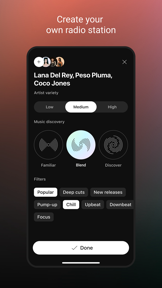
Algorithmically generated playlists based on user listening history and activity context
How much does it cost?
Freemium model uses ad-insertion to monetize free users while gating core utility features like background play and offline access behind a subscription.
Velocity
Intense developmentperformanceopaqueShow more...
The app maintains an intense release cadence of approximately 1.25 releases per week based on the observed data. Development appears to be managed via server-side feature flags or A/B testing, as all recent release notes are identical and generic, offering no visibility into specific functional changes. This pattern is consistent with high-velocity platforms that decouple feature deployment from App Store binary updates. The development trend remains stable and high-frequency, focusing entirely on performance and stability maintenance as reported by the publisher.
Who built it?
13+ apps tracked · Music
 Google Family Link
 Google Earth
 YouTube Kids
 Google TV: Watch Movies & TV
 Google Docs
 Photomath
 Gboard – the Google Keyboard
 Google One
 Google Keep - Notes and lists
 Google News
 Snapseed: Photo Editor
 Google NotebookLM
User Sentiment
What do users think recently?
Fresh user feedback skews frustrated. Users appreciate extensive music library access provides a vast catalog for diverse listening preferences across all genres, but report ui regressions following the latest update make playlist navigation and song management significantly more difficult.
How are ratings & reviews evolving?
What users say, by theme
- Extensive music library access provides a vast catalog for diverse listening preferences across all genres
- UI regressions following the latest update make playlist navigation and song management significantly more difficult
100 of 296 recent reviews analyzed · high confidence · Frustrated overall
Read the full review analysisUnlock 1 user request, each backed by review evidence.
Access the full report for freeCompetition
Competitive landscape for YouTube Music
How's the Music market?
YouTube Music holds a #1 Grossing position in the Music category, though its #15 Grossing rank on the overall US chart indicates that music-specific monetization faces stiffer competition for general user wallet share.
Read the market outlookThe rivals identified

By Pandora Media, LLC
Both apps compete for the same US-based audio listener segment by offering personalized discovery engines that reduce the manual effort of playlist curation.
- Pandora uses the Music Genome Project for granular track analysis, whereas YouTube Music relies on Google-powered search NLP for discovery.
- Pandora offers specific listening modes to adjust station output, while YouTube Music focuses on audio-video switching to increase session time.
 Audiomack - Play Music OfflineContender
 SoundCloud: The Music You LoveContender
 TIDAL Music: HiFi SoundContender
 Deezer: Music Player, PodcastContender
 Youtify - Music & PlaylistsContender
 Muze: Music DiscoveryContender
 Offline Music Player ‣‣Contender
 MusiTube: Your Music StreamingContender
Show 1 more

Unlock the head-to-head verdict: where this rival wins, and where it loses.
Access the full report for freeThe Analyst's Read
Key takeaways for YouTube Music
Where is it heading?
The music streaming market is consolidating around social-listening features and high-fidelity audio, leaving YouTube Music exposed to competitors that offer a more streamlined experience. Unless the team addresses the current UI friction and feature gaps, the app will continue to lose power users to rivals that prioritize audio-first utility.
- UI regressions in the latest update erode the daily active habit, which compounds the rating drag already visible on Android.
- Musi's free background-play workaround siphons casual users, accelerating churn pressure on the Premium conversion funnel into Q2.
The SWOT
- Official music video integration creates a unique content moat that pure-audio rivals cannot replicate
- Google-powered search NLP enables discovery of vague queries that outperform standard keyword-based search
- Integration of community-driven social features could counter Spotify's 'Jam' and 'Blend' retention loops
- Granular offline download controls would reduce data-drain complaints from mobile-first users
Next best moves
Rebuild playlist navigation because UI regressions are the top complaint theme → reduce churn
+ 1 more prioritized moveThe counter-intuitive read
The 'video-first' differentiator is actually a vulnerability…
Read the full takeFeature gaps
Social-first collaborative listening (available in Spotify but absent here) +1
Since the last report: The platform is experiencing a decline in user sentiment and increased churn pressure due to UI regressions and persistent feature gaps in audio customization.
Bottom line
YouTube Music defends its category lead through unique video-audio integration, but the latest UI regressions and lack of standard audio tools drive churn, so the PM must prioritize navigation stability to protect the subscriber base.
Unlock 2 critical frictions, 2 market threats, 1 more prioritized move and the analyst’s take.
Access the full report for freeReport last updated