


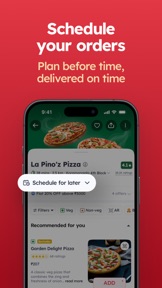


Zomato is a food delivery and restaurant discovery app for urban consumers in India and the UAE, operating on iOS and Android.
The App DNA
What makes this app unique?
Users rely on the platform to navigate diverse dining options and secure quick doorstep delivery, bypassing the limitations of single-brand ordering funnels.
For Urban consumers in India and the UAE seeking convenient food delivery, restaurant discovery, and event ticketing.
What does it look like?
Key features
Logistics network delivering iconic regional dishes from different cities to the user's doorstep.
UI filter that restricts search results and delivery fleets to vegetarian-only options.
Ticketing and discovery platform for local events and live experiences.
How much does it cost?
Monetization relies on transaction commissions and advertising inventory rather than recurring subscriptions.
Velocity
Active developmentperformanceopaqueShow more...
The app maintains an active release cadence of approximately 0.6 releases per week across iOS and Android platforms. Development appears stable, though the publisher consistently utilizes opaque release notes that offer no visibility into specific feature additions or improvements. This pattern is consistent with apps that rely on server-side feature flags or A/B testing rather than traditional App Store changelogs. There is no evidence of live-ops events or new feature announcements in the observed data.
Who built it?
Zomato Media Pvt
6 apps tracked · Food & Drink
 Zomato Restaurant Partner
 Urbanspoon - Restaurant & Food Reviews
 District: Movies Events Dining
 Hyperpure
 District Play Partner
User Sentiment
What do users think recently?
Recent user voice shows a mixed sentiment. Users appreciate fast delivery and reliable service keep users engaged when ordering food in unfamiliar locations and wide variety of vegetarian cuisine options makes the platform a preferred choice for specific dietary needs, but report unprofessional customer support and lack of escalation channels leave users without resolution for missing or delayed orders.
How are ratings & reviews evolving?
Weekly average review rating
What users say, by theme
- Fast delivery and reliable service keep users engaged when ordering food in unfamiliar locations
- Wide variety of vegetarian cuisine options makes the platform a preferred choice for specific dietary needs
- Unprofessional customer support and lack of escalation channels leave users without resolution for missing or delayed orders
120 of 30952 recent reviews analyzed · high confidence · Mixed overall
Read the full review analysisUnlock 2 more frustration themes and 1 user request, each backed by review evidence.
Access the full report for freeCompetition
Competitive landscape for Zomato: Food Delivery & Dining
How's the Food & Drink market?
Zomato holds a leading position in the Indian food delivery market, with a 4.68 rating across 131,231 iOS reviews. The platform's discovery-first model differentiates it from single-brand competitors, though transaction-based fees create ongoing friction with price-sensitive users.
Read the market outlookThe rivals identified

By Pizza Hut, Inc.
Both platforms compete for the same urban food delivery market share, with Zomato providing a broad restaurant discovery platform while Pizza Hut captures direct sales through a specialized, brand-specific ordering funnel.
- Zomato offers Intercity Legends for regional food variety, while Pizza Hut restricts users to its proprietary menu.
- Zomato provides a Veg Mode filter for dietary targeting, whereas Pizza Hut focuses exclusively on its pizza-centric catalog.
- Zomato maintains a 1.5 million restaurant discovery database, while Pizza Hut operates as a single-brand direct sales channel.
 Uber Eats: Food and GroceryContender
 DoorDash: Food, Grocery, MoreContender
 Uber Eats: Food & GroceriesContender
 Rappi - Deliveries in MinutesContender
 Just Eat - Food DeliveryContender
 Deliveroo: Food & ShoppingContender
 Wonder: Food DeliveryContender
 talabat: Food, grocery & moreContender

Unlock the head-to-head verdict: where this rival wins, and where it loses.
Access the full report for freeThe Analyst's Read
Key takeaways for Zomato: Food Delivery & Dining
Where is it heading?
The food delivery market is consolidating around multi-category platforms that bundle groceries and household essentials, putting pressure on Zomato's food-only model. Zomato must pivot its support and fee strategy to defend its discovery-based moat, or it risks losing its high-frequency user base to rivals like Uber Eats.
- Persistent support and payment complaints in the latest release suggest that current maintenance-mode updates fail to address critical user friction points.
- The 1.5 million restaurant database continues to provide a discovery depth that remains a strong retention driver for travelers and new users.
The SWOT
- 1.5 million restaurant database sustains discovery advantage
- Veg Mode filter targets specific dietary segments
- Intercity Legends provides unique regional inventory
- Localized pricing strategies in high-ARPU markets
- Integration of creator-referral loops for dining
- Expansion of Intercity Legends to new cities
Next best moves
Build human-escalation path for support because users report automated loops fail to resolve missing orders → reduce churn
+ 1 more prioritized moveThe counter-intuitive read
Zomato's massive restaurant database is a liability if…
Read the full takeFeature gaps
Integrated grocery delivery (available in Uber Eats and Bolt Food but missing here) +1
Since the last report: Zomato's competitive position is declining as persistent support failures and opaque fee structures drive users toward multi-category rivals. The platform's reliance on a discovery-first model is increasingly insufficient to offset operational friction.
Bottom line
Zomato's discovery advantage is currently undermined by support and fee-transparency failures that drive users to multi-category rivals. Addressing the support escalation path would unlock higher retention among the existing user base.
Unlock 3 critical frictions, 3 market threats, 1 more prioritized move and the analyst’s take.
Access the full report for freeFAQ
Is Zomato better than Uber Eats for food delivery?
Does Zomato have hidden fees?
What is a good alternative to Zomato?
Sources
- [1] Play Store listing, source
Report last updated