


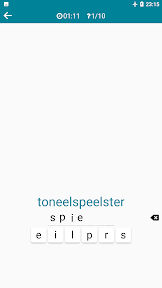
Afrikaans - German is an offline dictionary and language-learning app for Afrikaans and German speakers, featuring gamified tests and translation tools.
Product velocity
Maintenance
Daily rank 🇺🇸
—
Education
Sentiment
—
—
Nemesis

English Dictionary - Offline
The App DNA
What makes this app unique?
Users hire this app for offline vocabulary reference and structured language practice, serving learners who lack consistent internet access or prefer self-paced study.
For Language learners focusing on the Afrikaans and German language pair who require offline access and gamified study tools.
What does it look like?
Key features
Database of 60,000 Afrikaans to German and 72,000 German to Afrikaans words accessible without internet connection.
Multiple choice, writing, listening, and gap-filling tests to reinforce vocabulary retention.
Capability to manage favorites and word lists via csv, txt, xml, and html file formats.
How much does it cost?
Ad-supported model utilizing high-frequency engagement games to generate revenue.
Velocity
Maintenance developmentUX improvementsperformanceShow more...
The app has released only one update in the last 77 days, resulting in a cadence of approximately 0.09 releases per week. This falls into the maintenance tier, as the latest release focused on database and vocabulary updates rather than new feature development. The development trend is stable but minimal, with no evidence of live operations or frequent feature iteration. The publisher is currently focused on backend maintenance and minor interface adjustments.
Who built it?
eflasoft
13+ apps tracked · Education
 Russian - Dutch
 Romanian - English
 Lithuanian - English
 Bulgarian - Italian
 Chinese - Russian
 German - Swedish
 Indonesian - Portuguese
 Czech - English
 Hungarian - Russian
 Turkish - Arabic
 Polish - Spanish
 French - Hungarian
User Sentiment
What do users think recently?
How are ratings & reviews evolving?
Not enough recent reviews to extract reliable themes yet.
Read the full review analysisCompetition
Competitive landscape for Afrikaans - German
How's the Education market?
The app occupies a niche educational segment, competing against general-purpose dictionaries by providing specialized offline content for a specific language pair.
Read the market outlookThe rivals identified
By ZeeAlpha Tech
This app dominates the reference category by providing a massive, high-utility offline dictionary experience that directly competes with this app's core utility value proposition.
- Offers advanced OCR camera search functionality for instant text translation, which this app lacks.
- Maintains a massive user base and high review volume, creating a significant brand-as-category defensive moat.
- Includes specialized tools like a crossword helper, expanding utility beyond simple dictionary lookups for users.
 Te Aka Māori DictionaryContender
 Yoruba-English DictionaryContender
 Dictionary of CollocationsContender
 Slanglator: Teen Slang DecoderContender
Unlock the head-to-head verdict: where this rival wins, and where it loses.
Access the full report for freeThe Analyst's Read
Key takeaways for Afrikaans - German
Where is it heading?
The language-learning market is shifting toward AI-driven, interactive pedagogy, leaving static dictionary apps exposed. Afrikaans - German must pivot toward these interactive features to avoid being relegated to a secondary utility tool.
- The app maintains a steady offline-first utility, but the lack of AI-driven features limits growth against modern competitors.
- Competitors are increasingly adopting AI-driven OCR and conversation practice, which erodes the value of static dictionary lookups.
The SWOT
- 132,000-word offline database provides reliable utility for low-connectivity regions
- Data import/export functionality creates a switching cost for power users
- Integrate basic AI-driven pronunciation scoring to modernize the speaking test
- Expand into B2B partnerships for language-learning institutions
Next best moves
Integrate AI-driven pronunciation scoring because competitors like Articulate offer granular feedback → increase session value
+ 1 more prioritized moveThe counter-intuitive read
The app's reliance on offline-first utility is a…
Read the full takeFeature gaps
OCR camera translation (available in English Dictionary - Offline but missing here) +1
Since the last report: The app is pivoting from a static dictionary utility toward AI-integrated language learning to counter threats from AI-native and OCR-enabled competitors.
Bottom line
Afrikaans - German holds a stable niche through its offline database, but it risks obsolescence against AI-native competitors, so the PM must prioritize interactive speech-scoring features to retain users.
Unlock 2 critical frictions, 2 market threats, 1 more prioritized move and the analyst’s take.
Access the full report for freeReport last updated