


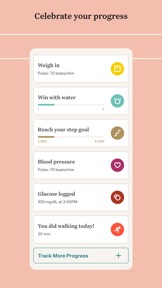


Noom is a health and fitness app providing behavioral psychology-based weight loss programs and clinical medication access on iOS.
The App DNA
What makes this app unique?
Users hire Noom to reframe their relationship with food through structured lessons, seeking a sustainable alternative to traditional calorie counting.
For Individuals seeking sustainable weight loss through behavioral psychology and those requiring clinical support for weight management.
What does it look like?
Key features
Daily lessons based on cognitive behavioral therapy.
Access to GLP-1 medications and clinician consultations.
Image-based and database-backed meal logging.
How much does it cost?
Tiered subscription model segmenting users by clinical needs.
Velocity
Active developmentopaqueperformanceShow more...
The app maintains an active development cadence, shipping 5 releases over the last 8 weeks, averaging roughly 0.6 releases per week. Despite this consistent frequency, the release notes are uniformly opaque, providing no insight into specific feature development or content updates. This pattern is consistent with apps that utilize server-side feature flags or A/B testing to manage updates rather than relying on App Store changelogs. The development trend is stable, focusing on continuous maintenance and iterative improvements.
Who built it?
Noom
2 apps tracked · Health & Fitness
 Noom: Weight Loss & GLP-1 Care
User Sentiment
What do users think recently?
Recent user voice shows a frustrated sentiment. Users appreciate educational daily lessons provide practical strategies for long-term weight management and healthy lifestyle changes, but report forced gamification features like virtual seeds distract from the core utility of food tracking.
How are ratings & reviews evolving?
What users say, by theme
- Educational daily lessons provide practical strategies for long-term weight management and healthy lifestyle changes
- Forced gamification features like virtual seeds distract from the core utility of food tracking
98 of 98 recent reviews analyzed · high confidence · Frustrated overall
Read the full review analysisUnlock 1 user request, each backed by review evidence.
Access the full report for freeCompetition
Competitive landscape for Noom Weight Loss, Food Tracker
How's the Health & Fitness market?
Noom sits #17 Grossing in the US Health & Fitness chart, but a 7-spot free-rank decline signals weakening top-of-funnel acquisition. The $69/month clinical tier creates a high-ARPU segment that differentiates it from the $17/month weight-loss base.
Read the market outlookThe rivals identified

By MyFitnessPal, Inc.
Both apps target weight loss seekers, but MyFitnessPal serves as the primary alternative for users prioritizing raw food database scale over Noom's behavioral psychology curriculum.
- MyFitnessPal maintains a 20.5 million item food database, while Noom lacks a crowdsourced repository.
- MyFitnessPal integrates with 40+ third-party apps, providing broader hardware connectivity than Noom.
- MyFitnessPal includes barcode scanning for food logging, a feature not present in Noom's core offering.
 Simple: AI Weight Loss CoachContender
 Cronometer: Calorie CounterContender
 Calorie Counter & Food TrackerContender
 Foodvisor - AI Calorie CounterContender
 Calo: AI Food Calorie CounterContender
 Calorie Counter - MyNetDiaryContender
 Fooducate: Nutrition CoachContender
 Omo: Healthy Weight Loss AppContender
Unlock the head-to-head verdict: where this rival wins, and where it loses.
Access the full report for freeThe Analyst's Read
Key takeaways for Noom Weight Loss, Food Tracker
Where is it heading?
The health-tracking market is consolidating around specialized clinical and behavioral tools, leaving Noom exposed to competitors that offer cleaner, more utility-focused interfaces. Unless the team pivots to allow user-controlled interface customization, the current churn pressure will continue to erode the user base through the next two quarters.
- Technical regressions in the latest update (data sync failures) erode the daily habit, compounding the rating drag on Android.
- Aggressive medication marketing creates friction for the core weight-loss base, leading to increased churn among non-clinical users.
The SWOT
- Psychology-based curriculum creates high switching costs
- Clinical integration provides high-ARPU revenue stream
- B2B partnerships for biomarker-based health programs
- Customizable UI to reduce user friction
Next best moves
Ship UI toggle to disable gamification features because user sentiment flags forced game elements as top churn risk → improve retention
+ 1 more prioritized moveThe counter-intuitive read
The #17 Grossing rank is a liability…
Read the full takeFeature gaps
Crowdsourced food database (available in MyFitnessPal) +1
Since the last report: The platform has pivoted toward clinical medication marketing and aggressive gamification, causing a decline in user sentiment and a drop in grossing rank.
Bottom line
Noom holds a strong niche in behavioral health, but the recent update’s intrusive gamification and technical instability alienate the core user base, so the PM must prioritize UI customization and data reliability to prevent churn.
Unlock 2 critical frictions, 2 market threats, 1 more prioritized move and the analyst’s take.
Access the full report for freeReport last updated