


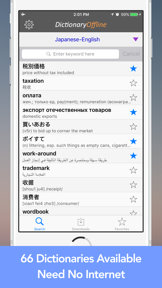

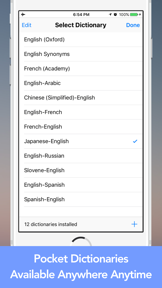
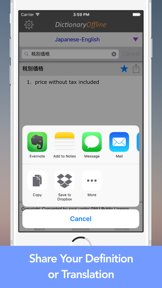
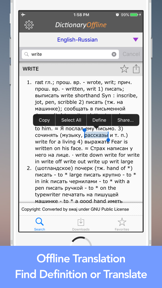
Dictionary Offline Free is a multi-language reference tool for iOS that provides offline word definitions and translations.
The App DNA
What makes this app unique?
Users hire this app to maintain access to linguistic reference tools in remote areas or during travel where data costs and connectivity are barriers.
For Travelers, students, and language learners who require reliable, offline access to multi-language dictionaries.
What does it look like?
Key features
Browse up to 66 dictionaries without an active internet connection.
Access to additional dictionaries including Merriam-Webster and Oxford.
How much does it cost?
Freemium model uses ad-supported free tier to drive volume, with Pro version gating additional dictionary databases and ad removal.
Velocity
Dormant developmentopaqueperformanceShow more...
Development has stalled, with the latest release occurring 230 days ago and the iOS platform remaining untouched for over 3,600 days. The release history shows a long-term trend of stagnation, shifting from a period of active dictionary expansion in 2012-2016 to a complete lack of feature development. Current updates are limited to generic bug fixes, confirming the app is in a zombie state with no active roadmap or operational support.
Who built it?
Tapclay
8 apps tracked · Reference
 Traffic Cam+ Pro
 StableCam 2: Video Stabilizer
 Traffic Cam+
 Orbit: Sun Position
 Dictionary Offline
 SolarApp: Sun & Shade Tracker
 Servebot for Jenkins
User Sentiment
What do users think recently?
The recent review mood reads excited. Users appreciate the offline dictionary functionality provides reliable access to definitions for users without consistent internet connectivity and diverse dictionary sources and thesaurus integration offer comprehensive vocabulary depth for language learners and readers, but report full-screen takeover ads disrupt the reading experience and frustrate users who prefer less intrusive banners.
How are ratings & reviews evolving?
Weekly average review rating
What users say, by theme
- The offline dictionary functionality provides reliable access to definitions for users without consistent internet connectivity
- Diverse dictionary sources and thesaurus integration offer comprehensive vocabulary depth for language learners and readers
- Educational features like word of the day and historical facts keep long-term users engaged daily
- Full-screen takeover ads disrupt the reading experience and frustrate users who prefer less intrusive banners
92 of 172 recent reviews analyzed · high confidence · Excited overall
Read the full review analysisUnlock 2 more frustration themes and 1 user request, each backed by review evidence.
Access the full report for freeCompetition
Competitive landscape for Dictionary Offline Free
How's the Reference market?
The app occupies a niche offline-first segment, though it lacks the update velocity of market leaders like Dictionary.com. Its reliance on static databases limits its ability to compete with AI-driven translation tools.
The rivals identified

By Curiosity Media
This app maintains the largest market share and consistent update cadence, serving as the primary benchmark for offline and online dictionary utility.
- Integrates daily content like Word of the Day to drive recurring daily active usage
- Offers a comprehensive suite of thesaurus and synonym tools alongside standard dictionary definitions
- Maintains a massive, professionally curated database that dwarfs smaller, niche-focused offline dictionary tools


Unlock the head-to-head verdict: where this rival wins, and where it loses.
Access the full report for freeThe Analyst's Read
Key takeaways for Dictionary Offline Free
Where is it heading?
The reference market is consolidating around AI-driven, frequently updated tools that offer contextual learning rather than static definitions. Without a pivot to cloud-based persistence and a reduction in ad friction, this app will continue to lose relevance to modern competitors.
- The lack of updates since 2016 leaves the app vulnerable to OS-level changes, which compounds the frustration of users experiencing data loss.
- Intrusive full-screen ads drive uninstall behavior, which erodes the user base faster than the offline utility can attract new, high-value users.
The SWOT
- Offline-first architecture removes connectivity dependency
- 66-dictionary library provides comprehensive multi-language breadth
- Implement cloud-sync for saved lists to reduce migration churn
- Introduce PDF/EPUB reader integration to capture reading-focused users
Next best moves
Ship cloud-sync for saved word lists because data loss during migration is a top user complaint → reduce churn
+ 1 more prioritized moveThe counter-intuitive read
The app's dormant release cadence is actually a…
Read the full takeFeature gaps
Cloud synchronization for saved lists (available in modern reference apps but missing here) +1
Bottom line
The app retains a loyal base through its offline-first utility, but the lack of cloud-sync and intrusive ads creates a churn risk that rivals are exploiting, so the PM must prioritize data persistence to stabilize long-term usage.
Unlock 3 critical frictions, 2 market threats, 1 more prioritized move and the analyst’s take.
Access the full report for freeFAQ
Does this app work without an internet connection?
How does this compare to Dictionary.com?
Are there intrusive ads in the app?
What is a good alternative for offline translation?
Sources
- [1] App Store, source
Report last updated