


Bumble Holding
For singles and individuals seeking platonic connections, with a specific emphasis on women looking for a controlled and safe digital environment.
 Bumble Dating App: Meet & Date




Snapshot
Who is Bumble Holding?
Empowering users to build intentional connections through a women-first messaging dynamic that prioritizes safety and respect.
Target audience


Portfolio
Free 4Last updated

Bumble Dating App: Meet & Date
v5.473.0
2mo ago
Publisher DNA
What defines Bumble Holding?
Publisher DNA
Primary focus
Lifestyle dating and social networking
Scale
indie
Target audience
Singles and individuals seeking platonic connections, with a specific emphasis on women looking for a controlled and safe digital environment.
Origin
Launched in 2014 to create a more respectful dating environment by putting women in control of the first move.
Signature Patterns
- •Women-first messaging dynamic as a core product differentiator
- •Multi-tiered freemium monetization via Boost and Premium subscriptions
- •Heavy emphasis on safety features including profile verification and Snooze Mode
- •Extensive localization supporting over 25 languages and regional storefronts
Portfolio momentum
Maintained a consistent update cadence with 6 releases in the last 6 months for its flagship title, indicating active development.
Company profile
medium confidence- Founded
- 2014
Portfolio
What does Bumble Holding ship?
Apps
4 apps analysed
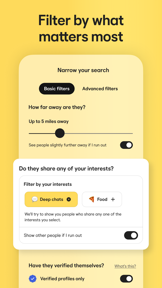
Dating app to meet new people, chat and date with singles IRL or make friends.


Verified-match requirement builds trust in the dating pool
- Long-term users report finding meaningful romantic connections that lead to successful real-world relationships
- Aggressive paywalls and subscription costs prevent users from accessing basic matching and communication features

Dating app to meet new people, chat and date with singles IRL or make friends.

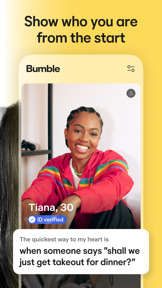

ID verification reduces bot-driven churn
- Occasional successful matches provide a positive dating experience for some users
- Users report: Aggressive monetization and pay-to-win mechanics create a perception of a scam

BFF is the friendship app to chat, meet new people near you and make friends IRL


- The core social connection loop provides meaningful friendship opportunities for users who successfully navigate the interface
- Frequent app crashes and freezing during navigation prevent users from maintaining active social conversations or matches

Analysis in progress
Distributed across 20 markets, strongest in Europe.
Based on 2 of 4 apps with localized market data, more coverage rolling in as scans complete · last scanned .
Americas (4)
- United States2 / 2
- Brazil1 / 2
- Canada1 / 2
- Mexico1 / 2
Europe (9)
- France1 / 2
- Germany1 / 2
- Italy1 / 2
- Netherlands1 / 2
- Portugal1 / 2
›+4 more europe markets
- Spain1 / 2
- Sweden1 / 2
- Turkey1 / 2
- United Kingdom1 / 2
Asia-Pacific (7)
- Australia1 / 2
- India1 / 2
- Indonesia1 / 2
- Japan1 / 2
- Singapore1 / 2
›+2 more asia-pacific markets
- South Korea1 / 2
- Vietnam1 / 2
Core markets (2/2 apps)
User Sentiment
How do users feel about their apps?
0
Positive apps
0
Neutral / mixed
3
Negative apps
15/100
Avg sentiment score
Unlock the app dragging this portfolio down.
Access the full report for freeRivals
Who does Bumble Holding compete with?
The rivals identified
Nemeses(2)

Both apps compete for the same dating audience by utilizing swipe-based discovery and profile matching as their primary interaction model.


Both apps compete for the same casual-to-serious dating audience using freemium models that gate core communication and discovery features behind paywalls.
Contenders(18)


Both apps target socially active individuals seeking connections, with Wink competing for the same user base by reducing profile creation friction through AI-assisted tools.


Badoo competes for the same dating and matchmaking audience by offering a free platform that prioritizes real-world connections and profile-based discovery. Both apps target users seeking romantic partners or social connections through a similar swipe-based interface.


Both apps compete for the same casual and long-term dating audience by utilizing freemium models that gate core messaging behind paywalls.


Both platforms compete for the same singles demographic, but Bumpy targets cross-border connections while Bumble focuses on local, women-first interactions.


Both apps compete for the same singles demographic by offering distinct filtering mechanisms to manage connection intent and user authenticity.


Both applications target the serious dating segment, with Evermatch positioning itself as a compatibility-focused alternative to the swipe-heavy discovery model used by Bumble.


Users report: Feeld captures the niche segment of non-monogamous and identity-curious users that Bumble's mainstream, safety-focused model fails to address. This creates a direct competitive overlap for users seeking specialized relationship structures beyond traditional dating.


Both apps target individuals seeking meaningful connections and utilize freemium models with aggressive paywalls, competing for the same user base in the US dating market.


Hinge competes for the same relationship-seeking demographic by replacing rapid-fire swiping with prompt-based profiles that force higher user investment.


iHappy competes for the same local dating audience as Bumble by offering a platform for both serious and casual connections. Both apps target users seeking romantic partners through location-based matching.


Both apps target the same singles demographic seeking romantic connections and social expansion, competing directly on the value proposition of free versus subscription-gated access to matching and communication.


Both apps compete for users seeking romantic connections, with Dating.com focusing on international discovery while Bumble prioritizes local, safety-oriented matching.


Both apps target singles seeking meaningful connections, competing for the same user base by offering distinct, non-swipe-only discovery mechanisms that prioritize compatibility over purely visual discovery.


PURE competes for the same casual dating demographic by offering privacy-focused, ephemeral communication tools that contrast with the profile-heavy, identity-verified approach of Bumble.


Lovector targets the same local dating audience as Bumble, focusing on proximity-based matching and relationship-seeking users. Both apps compete for the same user base looking for romantic connections and social expansion.


SweetMeet targets the same singles demographic seeking serious relationships, competing directly for user attention through shared interest-based profile discovery and local matching.


Tinder and Bumble compete for the same casual and long-term dating audience, with both platforms relying on swipe-based discovery and aggressive freemium monetization models.


Both apps target singles seeking connection, competing for the same user base by offering distinct approaches to match discovery and interaction frequency.
Same space(17)


Addresses the privacy concerns of users who find Bumble's open-access model too public for sensitive social or dating interactions.


Functions as a relationship coach and tracker for established couples, providing value after the initial connection phase.


Acts as a post-match tool for couples to manage their relationship, extending the user lifecycle beyond the initial dating phase.


Targets the same dating audience but shifts the focus from photo-first swiping to personality-based compatibility.


Eris provides a broader social-dating experience that includes video chat, contrasting with Bumble's primary focus on text-based matching.


Provides a culturally specific alternative for the Arab diaspora, filling a niche that Bumble's generalist approach may overlook.


Snoggle uses gamification to drive retention, offering a high-frequency alternative to Bumble's more deliberate, safety-focused matching.


Justlo competes for the same user base seeking long-term relationships but uses interest-based matching rather than Bumble's gender-gated messaging.


Targets high-net-worth individuals seeking professional or personal connections, narrowing the demographic focus compared to Bumble's broad market.


My Flirt targets the same social discovery demographic as Bumble but lacks the specific women-first messaging constraint.


Nymph occupies a specific niche for open-minded individuals, providing a specialized alternative to Bumble's broader dating focus.


Likerro serves as a lower-friction alternative for users frustrated by Bumble's subscription-gated communication.


Serves as a high-frequency hub for local social discovery, competing for the same user time as Bumble's location-based matching.


Captures the Gen Z social discovery segment with a swipe-based interface that prioritizes global interaction over Bumble's local focus.


Replaces the self-service swiping model with a human-in-the-loop matchmaker, addressing the fatigue of manual profile searching.


Focuses on the South Asian demographic by blending cultural traditions with modern romance, serving as a specialized alternative to Bumble.


Limits the dating pool to a specific university community, creating a high-trust environment that contrasts with Bumble's open-access model.
The Analyst's Read
The bottom line on Bumble Holding
Bottom line
Bumble is a dominant specialist in the lifestyle category, successfully defending its niche through a mission-driven product constraint. Their ability to maintain high user sentiment while scaling a single-app portfolio suggests a highly optimized product-market fit and strong brand loyalty.
Frequently asked questions
How many apps does Bumble Holding publish?
What kind of apps does Bumble Holding make?
What is Bumble Holding's top app?
In how many countries are Bumble Holding's apps available?
What fed this analysis
- Apps analyzed:
- 1
- With full intel:
- 1
- With overview:
- 1
- Website scraped:
- yes
- Social presence:
- yes
